



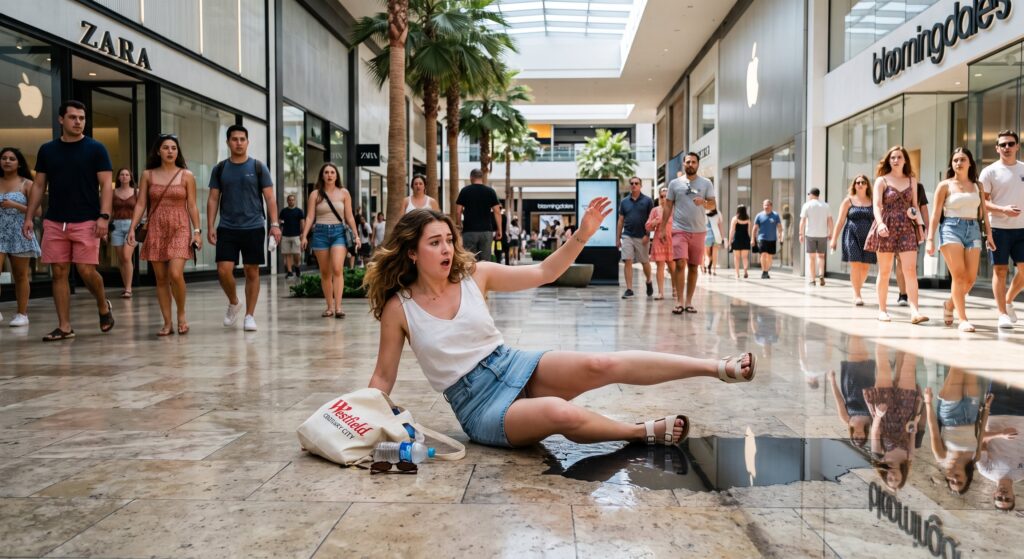
When July heat pushes Angelenos and tourists indoors, LA’s biggest shopping malls become some of the most crowded spaces in the city. That foot traffic also makes them some of the most hazardous. Spilled drinks, leaking AC condensation, and overworked staff who can’t keep up with the mess create wet floor hazards that can send a shopper to the hospital in an instant. If a negligent property owner caused your wet floor accident in Los Angeles, Lerner and Rowe can help you. You can trust our Los Angeles slip and fall lawyer team to do everything possible to maximize your settlement.
Premises liability claims in California require fast action. Surveillance footage gets overwritten, incident reports get buried, and property management companies have experienced insurance teams working to protect their interests from the moment a fall is reported. Lerner and Rowe’s experienced California injury attorneys get ahead of all of it from day one.
Summer Crowds and Indoor Hazards in LA
Summer in Los Angeles pushes indoor shopping traffic to its annual peak. The Glendale Galleria, Beverly Center, and Westfield Century City all see their busiest foot traffic of the year from late June through August. More shoppers means more spills, more AC units working overtime, and more tracked-in moisture from parking structures and outdoor food courts. It also means fewer staff per shopper, since summer turnover and scheduling gaps leave hazards unaddressed longer than they would be during quieter months.
A wet floor accident in Los Angeles at a major mall is rarely a random event. It is the predictable outcome of a property management decision to prioritize throughput over maintenance. California law holds property owners to a duty of reasonable care — when that duty fails and a visitor is injured, the business is accountable.
Suffering an Accident at Westfield Century City
An accident at Westfield Century City is a particularly common scenario for wet floor claims because the mall’s open-air and indoor hybrid layout creates conditions where outdoor moisture, food court spills, and condensation from cooling systems all converge on the same high-traffic terrazzo and polished concrete surfaces. The food hall level in particular sees heavy foot traffic from shoppers carrying drinks and ice cream while navigating narrow corridors to seating areas.
When a spill is not cleaned up promptly or a wet floor sign is placed only after a fall has already occurred, the property owner’s duty of care has been breached. Lerner and Rowe’s skilled attorneys request maintenance logs, incident reports, and surveillance footage from the moments before and after a fall at Westfield Century City or any other LA mall to establish exactly when the hazard appeared and how long management had notice of it before someone was hurt.
Causes of a Wet Floor Accident in Los Angeles
A wet floor accident in Los Angeles at a shopping mall, grocery store, or restaurant typically traces back to one of the following failures on the part of the property owner or their management team.
- Food court spills left unaddressed: High-volume food courts generate constant spill hazards. When staff response times lag behind the pace of traffic, spilled beverages and dropped food sit on smooth tile long enough to cause falls.
- AC condensation on floors: Commercial HVAC systems working at capacity in July regularly produce condensation that drips onto flooring near vents, units, and doorways. These puddles are invisible until someone steps in them.
- Tracked-in moisture: Shoppers entering from hot parking structures and outdoor areas track moisture from footwear onto interior tile, creating invisible slip hazards near entrances that go unmopped for extended periods.
- Inadequate wet floor signage: California law requires property owners to warn visitors of known hazards. A wet floor sign placed after the fact, placed in the wrong location, or never placed at all is evidence of negligence.
- Poorly maintained flooring: Cracked tile, uneven transitions, and flooring materials that become slippery when wet all represent maintenance failures that the property owner had an obligation to address.
Injuries From a Spilled Drink Fall in LA
A spilled drink fall in LA sounds like a minor mishap, but the injuries from hitting polished concrete or terrazzo at full adult body weight are anything but minor. Broken bones — particularly fractured wrists from bracing for impact, shattered kneecaps from a direct fall, and hip fractures in older victims — are among the most common outcomes and frequently require surgery, hardware implantation, and months of physical therapy.
When a fall involves a direct head impact, the consequences can be far more severe. Traumatic brain injuries from a slip and fall are often underdiagnosed at the emergency room because the victim is still conscious and may not show obvious neurological symptoms immediately. Headaches, cognitive fog, and personality changes that emerge days later may trace back directly to the fall — and the documentation created in the immediate aftermath is what connects them.
Fault in a Wet Floor Accident in Los Angeles
California’s pure comparative fault system means you can recover compensation for a wet floor accident in Los Angeles even if you were partly responsible for the fall. Your damages are reduced by your percentage of fault, but you are never completely barred from recovery. Property owners and their insurers will argue that you were not paying attention, wearing inappropriate footwear, or moving too fast. Lerner and Rowe’s experienced Los Angeles injury attorneys counter those arguments with the surveillance record and maintenance history of the property.
A negligent property owner in Los Angeles who had notice of a wet floor hazard and failed to address it within a reasonable time is liable for every injury that results. “Notice” can be actual, such as cases where staff saw the spill. It can also be constructive, in instances where the spill had been there long enough that staff should have seen it through reasonable inspection. Establishing which type of notice applies in your case is central to how the liability argument gets built.
Navigating Premises Liability Laws in California
Premises liability laws in California are governed by Civil Code Section 1714 and the negligence standard established by the state’s Supreme Court. Property owners owe a duty of care to all lawful visitors, including but not limited to shoppers, diners, and those invited onto the premises for commercial purposes. Duty of care requires reasonable inspection of the property, prompt response to known hazards, and adequate warning to visitors of any condition that cannot be immediately corrected.
California’s premises liability framework does not require proof that the property owner knew about the hazard. If a reasonable inspection program would have discovered the wet floor, the owner is liable. Lerner and Rowe’s California attorneys will obtain the property’s maintenance schedules, staff inspection logs, and training records to determine whether the management team fell short of that standard.
Wet Floor Accident in Los Angeles Injury Claims
A shopping mall injury claim in LA moves through a specific process that differs from car accident claims in important ways. The property owner’s risk management team will conduct their own investigation immediately after the incident and will document the scene in ways that favor the business. Lerner and Rowe sends preservation letters to the property within hours of being retained and, when necessary, pursues emergency court orders to prevent surveillance footage from being overwritten or incident reports from being altered.
Soft tissue injuries from a slip and fall, which includes damage to muscles, tendons, and ligaments in the back, neck, and shoulders, are among the most contested in premises liability claims because they do not show up on x-rays. These injuries require advanced scans, such as mechanical resonance imaging (MRI). These scans can be expensive if they’re not covered by your health insurance coverage.
On the other side, the insurance team representing the mall will argue your injuries are minor or preexisting. Lerner and Rowe works with top medical specialists who document soft tissue damage with specificity that withstands these challenges.
Maximizing a Shopping Mall Injury Claim in LA
The full value of a wet floor accident in Los Angeles claim extends well beyond the emergency room bill. Recoverable damages include ongoing medical treatment, physical therapy and rehabilitation, lost wages during recovery, pain and suffering, and more. In cases involving catastrophic injuries or paralysis from a severe fall, a fair settlement should account for decades of future costs.
Insurance adjusters for major mall properties are experienced at minimizing claims and will make early settlement offers that do not reflect what a claim is actually worth. Lerner and Rowe builds the demand from the ground up, with medical expert opinions, economic projections, and a documented account of the property owner’s notice and failure to act. You can trust our team to win you the full amount you’re entitled to under California law.
Contact a Wet Floor Accident in Los Angeles Attorney
The Los Angeles injury attorneys at Lerner and Rowe are available 24 hours a day, 7 days a week. Our team handles wet floor accident in Los Angeles claims, shopping mall premises liability disputes, and complex multi-party injury cases every day. You can trust our distinguished attorneys to fight for every dollar entitled to. Best of all, you won’t pay a dime unless we win, thanks to our “no fee promise.”
Call Lerner and Rowe today to schedule your free, no-obligation consultation. We’re available 24/7 by phone at 310-INJURED. You can also reach us online through our LiveChat agents or by submitting your case details through our encrypted contact form.
The information on this blog is for general information purposes only. Nothing herein should be taken as legal advice for any individual case or situation. This information is not intended to create, and receipt or viewing does not constitute, an attorney-client relationship.