



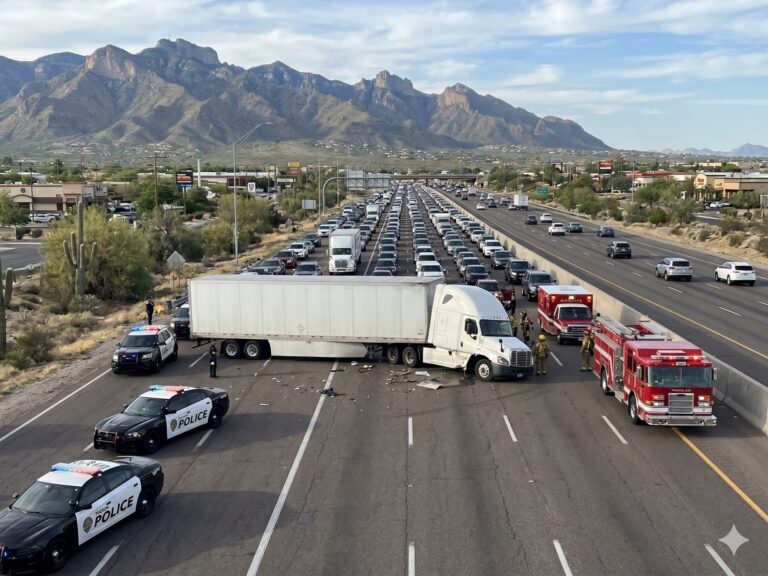
A semi-truck wreck on I-10 can shut down traffic for hours and leave behind crushed metal, shattered glass, and serious injuries. Truck accident claims are different from ordinary car accident claims. They often involve federal safety rules, electronic logging data, black box evidence, maintenance records, cargo records, and multiple insurance policies. If a crash like this hurt you or someone you love, an experienced truck accident lawyer in Tucson, AZ, from Lerner and Rowe Injury Attorneys can help you understand what happened, what evidence needs to be preserved, and what compensation may be available.
In this blog, we explain why I-10 and I-19 see so many commercial vehicle crashes, what often causes these wrecks, how Federal Motor Carrier Safety Administration (FMCSA) evidence can affect a claim, and why acting quickly after a Tucson truck accident matters.
Why I-10 and I-19 Are High-Risk Truck Routes
South of downtown Tucson, I-10 and I-19 connect two major freight corridors. I-19 carries commercial traffic north from the Nogales border crossing, while I-10 moves freight east and west across Arizona.
Several factors make this corridor risky:
- Heavy truck traffic: Many commercial vehicles pass through Tucson on tight delivery schedules.
- Border freight: I-19 serves international, regional, and local commerce between Mexico and the United States.
- Busy interchanges: Trucks merging between I-19 and I-10 must navigate changing speeds and heavy traffic.
- Crash history: Arizona Department of Transportation (ADOT) crash data from Tucson can help show crash trends, lane closures, traffic volume, and roadway conditions.
- Ongoing construction: ADOT’s I-10 Kino to Country Club project includes widening I-10, reconstructing interchanges, and adding ramp improvements.
- Work zone hazards: Lane shifts, narrowed shoulders, reduced speeds, sudden merges, and heavy commercial traffic can make crashes more likely.
- I-19 improvements: ADOT is also moving forward with improvements to the I-19 and Irvington Road interchange.
Common Causes a Truck Accident Lawyer in Tucson Investigates
Truck crashes can happen for many reasons, including:
- Driver fatigue: Long routes, tight delivery windows, and dispatch pressure can push drivers past safe limits.
- Speeding or driving too fast for conditions: A fully loaded tractor-trailer needs far more room to stop than a passenger vehicle. Speed becomes even more dangerous around construction zones, wet roads, congestion, and downhill grades.
- Brake failure: Worn components, low air pressure, skipped inspections, or ignored repair warnings can turn a preventable maintenance problem into a catastrophic collision.
- Overloaded or improperly loaded cargo: Overloaded or unevenly loaded freight can make a semi-truck harder to steer, harder to stop, and more likely to roll over.
- Distracted driving: A few seconds spent looking at a phone, GPS, dispatch message, or onboard system can be enough to cause a crash.
- Poor hiring or training: Trucking companies may be liable when they put unsafe, unqualified, or poorly trained drivers on the road.
These wrecks can lead to a variety of injuries or even death. If your family lost someone in a commercial truck crash, our team can explain what a wrongful death claim may look like under Arizona law.
FMCSA Evidence in Truck Wrecks
When negligent or reckless actions contributed to a crash, an experienced I-10 truck accident attorney in Tucson will know where to look first.
The FMCSA Hours of Service regulations limit how long many commercial drivers can drive before taking required rest. These rules include daily driving limits, on-duty time limits, required breaks, weekly hour caps, and restart periods. If a driver violates those rules and causes a crash, that violation can become powerful evidence in a personal injury claim.
After a Tucson truck accident, attorneys may request and compare:
- Driver logs
- Electronic logging device (ELD) data
- Dispatch records
- Fuel receipts
- GPS data
- Delivery schedules
- Inspection records
- Maintenance records
These records can show if the driver worked too many hours, if the trucking company set an impossible delivery schedule, or if the driver’s log does not match the truck’s actual location.
Truck Accident Lawyer in Tucson, AZ, and Black Box Evidence
If you were hurt in an I-19 semi-truck crash in Tucson that investigators are still reviewing, preserving evidence is one of the most important early steps. Modern commercial trucks may contain several electronic systems that help show what happened before impact.
People often refer to this information as “black box evidence.” FMCSA black box evidence in Tucson cases can help answer critical questions:
- Was the truck speeding?
- Did the driver brake too late?
- Was the truck already showing mechanical problems?
- Was the driver over the legal hours limit?
- Did the truck slow down at all before impact?
This data might not be saved forever. Data can be overwritten, lost, or changed as the truck returns to service. This is why a formal preservation letter, sometimes called a spoliation letter, should be sent quickly after the crash.
If you are not sure whether this evidence has been preserved in your case, it may be time to contact a truck accident lawyer in Tucson, AZ, before critical records disappear.
Truck Accident Lawyer in Tucson, AZ, and Company Liability
Arizona trucking company liability is often more complicated than it appears. The driver may have caused the collision, but the company may still be responsible if its own careless actions contributed to the crash.
A trucking company may be liable for:
- Negligent hiring and training
- Poor supervision
- Hours-of-service violations
- Unsafe dispatch practices
- Failure to inspect or maintain the truck
- Overloaded or unsecured cargo
- Keeping unsafe trucks in service
- Pressuring drivers to meet unrealistic delivery schedules
Other parties may also share responsibility, including:
- The truck driver
- The motor carrier
- A cargo loading company
- A maintenance contractor
- A broker or shipper
- A parts manufacturer
- Another driver
This matters because serious truck crashes can cause damages that go far beyond a single insurance policy. A commercial vehicle accident attorney in Tucson can investigate every possible source of recovery instead of stopping with the first insurance company that calls.
Carrier Insurance Minimums vs. Actual Damages
Federal insurance minimums do not always reflect the real cost of a serious truck crash. According to FMCSA insurance filing requirements, many for-hire property carriers hauling non-hazardous freight in vehicles with a gross vehicle weight rating of 10,001 pounds or more must carry at least $750,000 in public liability coverage. Certain hazardous materials carriers may need $1 million or $5 million in coverage, depending on what they transport.
That number may sound large, but a severe truck crash can quickly exceed it. Emergency care, surgery, hospitalization, rehabilitation, lost income, reduced earning capacity, pain and suffering, and long-term disability can push damages far beyond the minimum policy.
That is why identifying every responsible party matters. If one policy is not enough, an attorney may look for additional insurance coverage, umbrella policies, broker liability, maintenance contractor liability, cargo loading issues, or product liability claims involving defective truck parts.
How a Truck Accident Lawyer in Tucson Values Settlements
A Tucson truck accident settlement depends on the facts of the crash, the strength of the evidence, the severity of the injuries, the available insurance, and how clearly liability can be shown.
Important factors may include whether the truck driver violated FMCSA rules, whether ELD or black box data supports your claim, whether maintenance records show ignored problems, whether cargo was overloaded or improperly secured, whether you suffered permanent injuries, and whether the insurance company disputes fault.
Truck accident cases often require more investigation than ordinary car accident claims. The insurance company may have a response team working immediately after the crash. The trucking company may also control records that injured victims cannot easily access on their own.
That is why early legal help can make a major difference. A truck accident lawyer in Tucson, AZ, can send preservation letters, request commercial vehicle records, identify all possible defendants, calculate damages, and prepare the claim for negotiation or litigation.
When Pima County Superior Court Procedure Matters
Many truck accident cases settle before trial, but some must go to court. When that happens, the case may proceed through Pima County Superior Court, depending on where the crash occurred and which parties are involved.
An 18-wheeler accident lawyer in Pima County should understand how commercial vehicle cases are built for litigation. These cases can involve extensive discovery, including document requests, depositions, driver files, maintenance records, expert reports, medical evidence, and accident reconstruction analysis.
Pima County procedure matters because court deadlines and discovery rules can shape the timeline of the case. A trucking company may have control over key records, including driver logs, ELD data, inspection records, maintenance files, dispatch communications, and cargo documents. If those records are not requested correctly and early enough, important evidence may be harder to obtain later.
What to Do after an I-10 or I-19 Truck Accident
After a serious truck crash, your first priority should be your safety and medical care. Once you are able, these steps may help protect your health and your claim:
- Call 911: Make sure police and emergency medical responders come to the scene.
- Get medical care: Some injuries are not obvious right away, especially after a high-impact crash.
- Do not argue about fault: Stick to the facts when speaking with police.
- Take photos or videos if safe: Capture vehicle positions, damage, skid marks, road conditions, construction signs, debris, injuries, and identifying information on the truck.
- Get witness information: Names and phone numbers can be important later.
- Avoid giving a recorded statement to the trucking insurer: The insurer may try to use your words against you.
- Do not accept a fast settlement: Early offers may not reflect the full cost of your injuries.
- Contact an attorney quickly: Evidence preservation is especially important in commercial truck cases.
The sooner a legal team can begin investigating, the better chance they have of preserving evidence that supports your claim.
Why Hire a Truck Accident Lawyer in Tucson, AZ?
A truck accident lawyer in Tucson, AZ, can move quickly to protect evidence that may not be available for long. Trucking companies and their insurers often have investigators working soon after a serious crash. Injured victims should not have to face that process alone while they are dealing with medical treatment, vehicle damage, missed work, and pain.
An attorney can send evidence preservation letters, request driver logs, review inspection and maintenance records, examine black box data, identify every possible insurance policy, and determine whether the trucking company, driver, loading company, maintenance provider, or another party may be responsible.
This matters because commercial trucking cases are usually document-heavy. The police report may tell part of the story, but it rarely tells the whole story. The strongest cases often come from comparing several records at once and finding the gap between what the trucking company claims happened and what the evidence actually shows.
FAQs: Truck Accident Lawyer in Tucson, AZ
How long do I have to file a truck accident claim in Arizona?
Arizona Revised Statutes 12-542 gives most injury victims two years from the date of the crash to file a lawsuit. Wrongful death claims generally follow the same two-year deadline. However, some claims may have shorter notice requirements, especially if a government entity is involved.
Who can be held liable after a Tucson truck accident?
Liability may extend beyond the driver. The trucking company, cargo loading company, maintenance contractor, broker, shipper, parts manufacturer, or another negligent driver may share responsibility depending on what caused the crash.
What is black box evidence in a truck accident case?
Black box evidence may include speed, braking, engine activity, driver hours, GPS information, and other electronic data from the truck. This evidence can help show what happened before impact.
What if the trucking company’s insurance is not enough?
If damages exceed the available policy limits, an attorney can investigate whether additional insurance or additional liable parties may be available. This may include umbrella policies, third-party contractors, brokers, or product liability claims.
How is fault determined in an I-10 or I-19 truck crash?
Investigators may review the police report, crash scene evidence, witness statements, ELD data, black box records, maintenance records, cargo records, driver logs, and expert accident reconstruction findings.
Contact a Truck Accident Lawyer in Tucson, AZ
If you need a truck accident lawyer in Tucson, AZ, after an I-10 or I-19 crash, Lerner and Rowe Injury Attorneys is ready to help. Our Tucson office can help you understand your rights, preserve key trucking evidence, and deal with the insurance companies while you focus on your recovery.
We have recovered billions of dollars for clients nationwide, including over a billion dollars in the past three years alone. With no fees unless we win, reaching out costs you nothing.
Call, use LiveChat, or fill out our online contact form to schedule a free consultation.
The information on this blog is for general information purposes only. Nothing herein should be taken as legal advice for any individual case or situation. This information is not intended to create, and receipt or viewing does not constitute, an attorney-client relationship.