


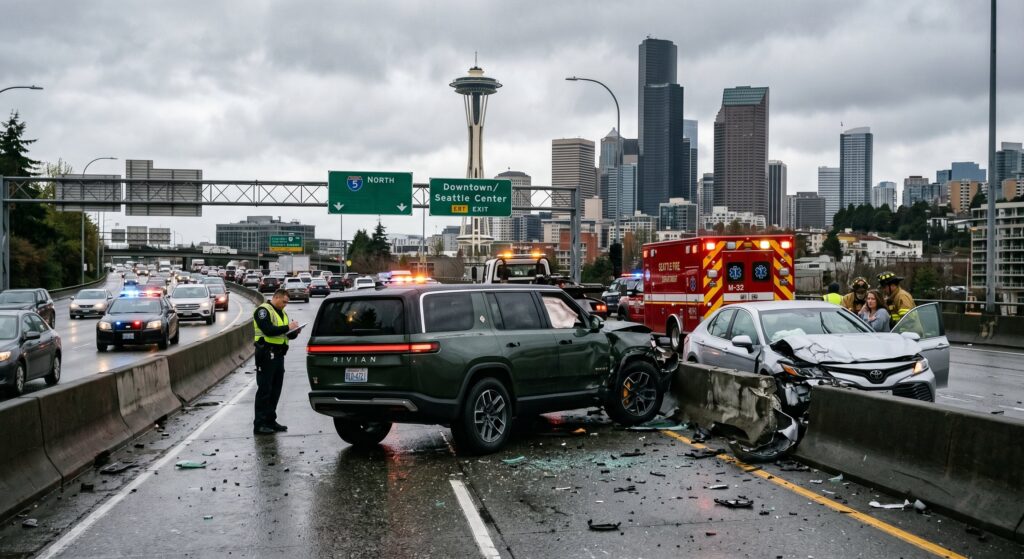
The Revive I-5 project is bringing a complete northbound shutdown of I-5 from I-90 to Northeast 45th Street from June 5 through June 8, 2026, just days before Seattle hosts the FIFA World Cup. When an interstate carrying hundreds of thousands of daily trips goes dark for a full weekend, the resulting detour congestion creates exactly the conditions where a serious Revive I-5 construction accident happens. If a distracted or aggressive driver hit you during the closure or on a detour route, a Seattle car accident lawyer from Lerner and Rowe can investigate your crash and fight to recover every dollar you are owed.
Construction zone crashes in Seattle are not always simple liability cases. The detour driver who rear-ended you, the contractor responsible for inadequate signage, and WSDOT itself may all share responsibility depending on the circumstances. Lerner and Rowe’s skilled construction zone accident attorneys know how to identify every liable party and build the case that holds them accountable.
June 2026 Revive I-5 Weekend Closure
WSDOT’s Revive I-5 project is removing the Ship Canal Bridge work zone deck during the June 5-8 closure window. This is the most extensive single-weekend I-5 shutdown in recent Seattle history. Northbound traffic that normally flows through downtown Seattle and the University District will be rerouted onto surface streets, pushing enormous volumes of cars through neighborhoods and intersections not built to handle freeway-level throughput.
The closure comes at a particularly volatile time. Seattle World Cup traffic is already straining the regional road network, with international visitors unfamiliar with Seattle streets arriving in large numbers. The combination of a major freeway closure and a global sporting event creates a high-frustration driving environment where your chance of an automobile crash greatly increases.
Ship Canal Bridge and Northbound Shutdown
The Ship Canal Bridge carries northbound I-5 over the Lake Washington Ship Canal between Seattle and the University District, and it is the geographic center of the Revive I-5 closure zone. Drivers who normally use this crossing to reach the University of Washington, Northgate, or points north will have no freeway option during the closure window. WSDOT has designated detour routes through Eastlake Avenue, Dexter Avenue, and Aurora Avenue North. However, these corridors are already among Seattle’s most congested surface streets under normal conditions.
A Ship Canal Bridge auto accident during the closure is most likely to happen on the detour routes feeding into and out of the closure zone, not on the bridge itself. In these areas, lane configurations change abruptly and drivers who missed signage make sudden U-turns or erratic cross-traffic maneuvers. Lerner and Rowe’s experienced Washington injury attorneys document these scenes quickly because road configurations in active construction projects change fast.
Causes of a Revive I-5 Construction Accident
Most Revive I-5 construction accident claims trace back to a predictable set of contributing factors. Identifying which ones apply to your crash is the first step toward establishing liability. Accident causes our knowledgeable Washington automobile accident lawyers anticipate include:
- Detour unfamiliarity: Drivers who rely on I-5 daily have no experience navigating the designated detour corridors. Unexpected turns, missed signals, and abrupt stops are common among drivers following GPS reroutes for the first time.
- Inadequate signage: Federal work zone standards require advance warning signage at specific distances. When WSDOT or a contractor fails to meet those standards, every crash that results carries a potential government liability angle.
- Distracted driving: Drivers managing navigation apps, talking on phones, or looking for detour signs are not watching the road. In slow detour traffic, that inattention translates directly into rear-end collisions.
- Aggressive lane changes: Frustrated drivers seeking faster routes make sudden, unsignaled lane changes on unfamiliar surface streets, forcing other drivers into curbs or parked vehicles.
- World Cup tourist traffic: International visitors unfamiliar with Seattle’s road rules and street layout add an additional layer of unpredictability to an already strained road network.
- Rideshare congestion: Uber and Lyft demand surges during major closures, flooding detour routes with rideshare vehicles that double-park, block intersections, and create sightline hazards for following traffic.
Rear-End Collisions in Heavy Detour Congestion
Rear-end crashes are the most common injury accident type in construction zone detour traffic, and they are also among the most underestimated. A low-speed rear-end strike in bumper-to-bumper traffic on Eastlake Avenue or Aurora can cause whiplash and spine injuries that take days to fully present. Insurance companies routinely argue that slow-speed impacts cannot cause serious injuries. Lerner and Rowe’s Seattle injury attorneys know how to counter that argument with medical evidence.
A Northeast 45th Street collision near the northern terminus of the closure zone is especially dangerous because drivers approaching from the University District are emerging from the detour network onto a major arterial without clear guidance on where the normal freeway access resumes. That moment of driver confusion at a busy intersection is where serious car wrecks happen.
Fault in a Revive I-5 Construction Accident
Washington follows a pure comparative fault system, meaning you can recover compensation proportional to the other party’s share of responsibility even if you were partially at fault. In a Revive I-5 construction accident, fault may rest with a distracted driver, a rideshare company, a construction contractor, or WSDOT, depending on the specific conditions that caused your crash.
Claims against government agencies in Washington require strict procedural compliance, including a tort claim notice filed within the applicable statute of limitations. A Seattle car accident lawyer from Lerner and Rowe handles those procedural requirements from the start so your claim against every liable party stays on track.
World Cup Traffic and Distracted Drivers
The FIFA World Cup brings a once-in-a-generation volume of international visitors to Seattle’s road network. Many of these drivers are navigating rental cars in a city they have never visited, using foreign navigation apps, and operating under different road rules than their home countries. On the weekend of June 5-8, those drivers will encounter a major freeway closure with no prior experience of Seattle’s detour alternatives.
A Seattle World Cup traffic injury claim involving an out-of-country driver adds complications that require an experienced attorney. International insurance policies, foreign driver’s licenses, and jurisdiction questions all come into play. Lerner and Rowe’s attorneys handle these cross-border claims and ensure Washington law governs your recovery regardless of where the at-fault driver is from.
The Lumen Field event district and the surrounding SoDo neighborhood will see some of the heaviest World Cup-related traffic concentration. Distracted drivers navigating between the stadium, downtown hotels, and the I-5 detour network will be crossing multiple high-risk intersections in an area already dense with pedestrian and rideshare activity.
FAQ: Revive I-5 Construction Accident Claims
Who is liable for a Revive I-5 construction accident?
Liability can fall on the at-fault driver, the rideshare company if a rideshare vehicle was involved, the construction contractor if inadequate signage or road conditions contributed to the crash, or WSDOT if the detour design was unreasonably dangerous. In many cases more than one party shares responsibility, and Lerner and Rowe investigates every angle from the start.
What if a rideshare vehicle causes a detour wreck?
Rideshare liability depends on whether the driver was actively transporting a passenger, waiting for a match, or off duty at the time of the crash. Each status triggers a different insurance tier, and the rideshare company’s legal team will argue for the lowest possible coverage. A Seattle rideshare accident lawyer at Lerner and Rowe knows how to challenge that argument and pull the full commercial policy into your claim.
Do I need a police report for a work zone collision?
Yes. A police report documents the road conditions, lane configuration, and contributing factors at the time of your crash, all of which are critical in a construction zone claim where physical conditions change daily. Call 911 at the scene and request that an officer respond even if the other driver suggests handling it privately.
What is the deadline for a Revive I-5 construction accident claim?
Washington’s statute of limitations for personal injury claims is generally three years from the date of the accident under RCW 4.16.080. Claims involving a government agency like WSDOT require a separate tort claim notice filed within that window and may have additional procedural requirements. Contact Lerner and Rowe as soon as possible after your crash to make sure every deadline is met.
How can a Seattle auto accident lawyer help me?
A Seattle auto accident lawyer from Lerner and Rowe investigates the crash scene, obtains camera footage and contractor records before they disappear, handles all communication with insurance companies, identifies every liable party, and calculates the full value of your claim including future medical costs and lost earning capacity. You focus on recovery while we handle everything else.
Contact a Revive I-5 Construction Accident Lawyer
The Seattle injury attorneys at Lerner and Rowe are available 24 hours a day, 7 days a week. Our team handles Revive I-5 construction accident claims, disputes with contractors and government agencies, and battles with insurance adjusters every day, and we fight to recover the highest compensation allowed under Washington law. Reach out today for your free, no-obligation consultation.
You can reach Lerner and Rowe Injury Attorneys by phone at 206-333-4400. If you prefer to contact us through the Internet, you can communicate with our online LiveChat representatives or submit your consultation request through our secure contact form.
The information on this blog is for general information purposes only. Nothing herein should be taken as legal advice for any individual case or situation. This information is not intended to create, and receipt or viewing does not constitute, an attorney-client relationship.