



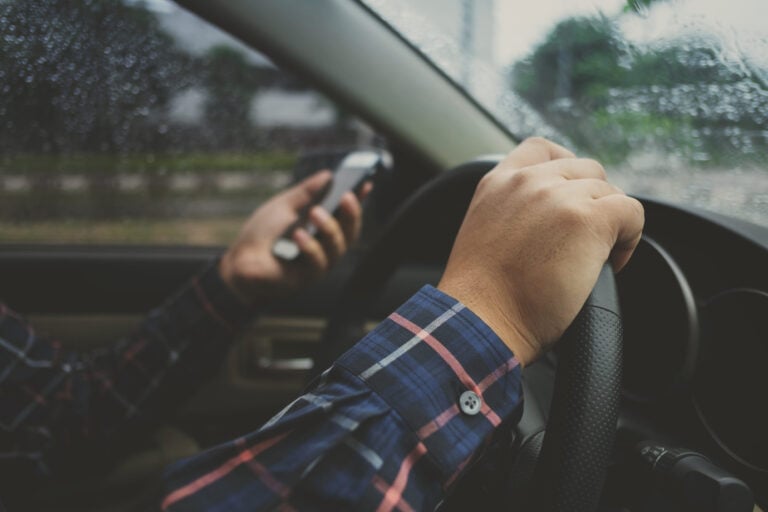
If you’ve been hurt in a crash along Route 59, there’s a chance a phone or other distraction was to blame. We know that’s a frustrating thing to experience and an even harder thing to prove. The good news? Illinois law gives us real tools to find out — and to hold the right driver accountable. Route 59 is one of the busiest corridors in the western suburbs, cutting through Aurora and up into Naperville with heavy retail traffic, school zones, and a steady stream of commuters glancing down at their phones at exactly the wrong moment. If that sounds familiar, read on for this guide from the Aurora car accident lawyers at Lerner and Rowe and learn what to do after a distracted driving crash on Route 59 in Aurora, IL.
Illinois’ Hands-Free Driving Law: 625 ILCS 5/12-610.2
Illinois has one of the stricter distracted driving laws in the country, and it’s worth understanding because it can have a serious impact on your eventual personal injury claim.
Under Illinois distracted driving law, 625 ILCS 5/12-610.2, drivers can’t use a handheld electronic communication device — think phones, tablets, or laptops — while operating a vehicle on a roadway. That covers the obvious things like texting and speaking with the phone up to your ear, but it also reaches further. The law specifically bars streaming or watching video, joining a video call on platforms like Zoom or Teams, and scrolling social media apps like Instagram, Snapchat, or Facebook while driving.
There are exceptions—hands-free use is okay; the same goes for voice-activated calls and an emergency call to get help. You’re also allowed to pull over to the side of the road if you really need to make a call in an emergency situation. But if a driver was using their phone at the time of the crash, they were probably breaking the law.
This can be a big deal when it comes to your texting and driving accident claim in Illinois. If we can show the other driver was violating that law at the moment of the crash, that really goes a long way to proving they weren’t being careful, and that’s exactly what we need to prove in a personal injury case. Illinois law gets even more serious when injuries are involved — a distracted driver who causes a serious injury can actually be charged with a Class A misdemeanor — and if it was a fatal accident, then it’s a Class 4 felony.
Distracted Driving Crash on Route 59 in Aurora, IL: Proving Phone Use
The hard truth is, drivers rarely admit to being on their phone, and it can be difficult proving cell phone use after a car accident in Illinois. So how do we actually prove they were distracted at the time of the crash?
- Phone records — Phone records can provide compelling evidence that the driver was actively using their device at or near the time of the crash. When combined with other evidence, they can strongly support a claim that negligent distracted driving caused the collision.
- Accident reconstruction — We can also get an expert to look at the skid marks, the way the vehicle was damaged, and the speed at which the accident happened. And if the driver never hit the brakes, and the phone records show the device was active at the same time, that combination of evidence can strongly support the conclusion that the driver was distracted.
- Vehicle data — Many modern vehicles store all sorts of information on what the driver was doing right before the crash — speed, braking, steering input — from the vehicle itself. That can either back up or contradict the driver’s story.
Put all this together, and it tends to blow their story out of the water. So whatever excuse they come up with — when we’ve got the evidence to show exactly when they were on the phone, they’ll have a hard time arguing otherwise.
Aurora and Naperville — Distractions Are Common Here
Route 59 is no ordinary road — this is one of the busiest retail and residential areas in the west suburbs, with a constant flow of traffic in and out of places like Ogden Avenue, Diehl Road, and 95th Street. The stop-and-go traffic all day long is a perfect storm for a distracted driver — all those lights, turns, and driveways lead to people getting caught up on their phone. Before you know it, they’ve missed a red light or haven’t seen a car stopped ahead.
Distracted driving near school zones may be viewed especially seriously because of the heightened presence of pedestrians and children, and the surrounding circumstances may increase both criminal and civil exposure depending on the facts. If your accident happened near a school zone crossing on Route 59 or a nearby side street in Naperville, that’s an important fact to flag for your lawyer right from the start — it can affect the other driver’s criminal exposure and the strength of your civil claim.
We’ve seen this pattern play out time and time again: a driver glances at their phone at a green light, and then misses the moment traffic in front of them stops — which leads to them rear-ending the car in front of them right as they’re about to enter the intersection. This is a preventable problem, and when it does happen, the law makes sure the distracted driver is held accountable.
Rear-end crashes and failure-to-yield collisions at intersections are two of the most common types of accident we see along this stretch of road — and both tend to leave behind the kind of physical evidence — the final resting positions of the vehicles, skid patterns, and traffic camera footage — that can really make a strong distraction claim when you pair it with the phone records.
Illinois’ Modified Comparative Fault Rule — Evidence Can Make a Difference
Illinois follows a modified comparative fault rule — which means you can still get some compensation even if you yourself were partly to blame for the crash — as long as you’re not more than 50% to blame. Your total recovery will simply be reduced by your percentage of fault.
Here’s where insurance companies commonly engage in deceptive practices. If they can’t deny the crash ever took place, they’ll try to shift some of the blame on to you. But when you can show that the other driver was on their phone the moment the crash happened, that makes it a whole lot harder for them to convincingly claim you shared some of the blame.
Distracted Driving Crash on Route 59 in Aurora, IL FAQs
1. What should I do after a distracted driving crash on Route 59?
You should call 911; get a medical check-up even if you feel fine; and if you can, take some photos of both cars, the road, and any visible injuries too. Try to get the other driver’s details and see if there were any witnesses around.
2. How do I figure out if the other driver was on their phone?
You probably won’t be able to find out on your own. That’s one of the reasons a phone records subpoena for a car accident case in Illinois and accident investigations is so important — they can usually give you information on what the driver was doing when the crash happened.
3. What if I was partly to blame — can I still make a claim?
Yes, you can still go ahead with a claim even if you were partly to blame. Illinois has a rule where you can still get some compensation as long as you weren’t more than 50% to blame. If that’s the case, you’ll still get something, but it will be reduced by your amount of fault.
4. How long do I have to file a claim after a crash in Illinois?
Illinois generally allows two years from the date of the crash to file a personal injury lawsuit. That said, evidence like phone records can disappear quickly, so it’s best not to wait to start building your case.
5. What if the crash happened in a school zone along Route 59?
Illinois law restricts cell phone use in school zones even more strictly. If your crash happened near a school zone, that detail can strengthen your claim and increase the other driver’s legal exposure — make sure to mention it right away.
Call an Aurora, IL Distracted Driving Route 59 Crash Lawyer
If you’ve been hurt in a distracted driving crash on Route 59 or anywhere in the Aurora or Naperville area, you don’t have to sort through phone records and accident reports on your own. Our Aurora personal injury lawyer team knows how to get the evidence that proves what really happened — and how to use it to build your claim.
Call our Chicago-area office at (844) 977-1900 today. You can also use our LiveChat service or fill out a convenient online contact form. We’re ready to talk through what happened and help you figure out your next steps.
The information on this blog is for general information purposes only. Nothing herein should be taken as legal advice for any individual case or situation. This information is not intended to create, and receipt or viewing does not constitute, an attorney-client relationship.