



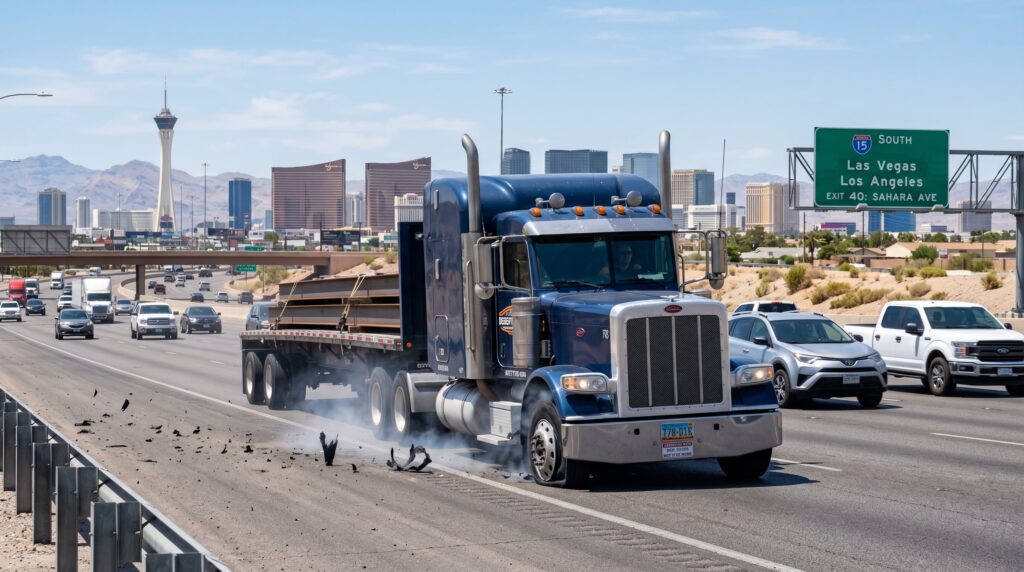
When a fully loaded 18-wheeler loses a tire at highway speed, the consequences happen fast. The driver can lose control of an 80,000-pound rig in seconds, crossing lanes, jackknifing, or sending chunks of shredded rubber flying into traffic. Every summer, Las Vegas sees a surge of serious semi-truck crashes on its busiest corridors, many of them traced back to tire failure. If an 18-wheeler tire blowout caused your injuries, a Las Vegas truck accident lawyer from Lerner and Rowe can investigate who is responsible and fight to hold them accountable.
Trucking companies will try to deflect blame after a wreck. Their insurers move immediately to protect the company, and evidence like tire inspection logs, maintenance records, and electronic data from the truck disappears fast. The sooner you contact a Las Vegas truck accident lawyer from Lerner and Rowe, the better your chances of receiving a full and fair settlement.
Las Vegas Triple-Digit Heat and Commercial Trucks
Las Vegas summers are hard on everything, but they are especially punishing on commercial truck tires. When ground temperatures on Nevada pavement climb past 150F, the heat attacks tire rubber from the outside while internal pressure builds from within. A tire that passed inspection in cooler weather can fail catastrophically once a truck is rolling across the superheated asphalt of a Nevada highway.
Trucking companies operating summer routes through the Mojave region have a responsibility to account for extreme conditions. Failure to adjust tire pressure, swap out worn treads before a long haul, or schedule maintenance around heat forecasts all constitute the kind of commercial truck maintenance negligence that can put every motorist on the road in danger.
High Temperatures on I-15 and U.S. 95 Corridors
The stretch of I-15 that runs through the southern end of Las Vegas, past the Speedway District and into North Las Vegas, carries some of the heaviest commercial truck traffic in the Southwest. Warehouse corridors near Craig Road and the Tropical Parkway interchange see dozens of semi-truck runs every hour, many loaded with freight heading toward California ports or Arizona distribution hubs.
U.S. 95 is equally demanding. The section running northwest toward the Nevada Motor Speedway area and out toward Summerlin sees consistent heavy hauler traffic even through the peak of summer. For a tire already stressed by load and distance, even a short additional stretch of scorching pavement can trigger a summer heat trucking collision that injures multiple motorists.
An I-15 semi-truck crash Las Vegas often involves multiple vehicles because of the speed and volume of traffic. Passenger cars caught in a blowout scenario have very little time to react, and the injuries are frequently severe.
What Causes an 18-Wheeler Tire Blowout in Nevada?
An 18-wheeler tire blowout rarely happens without warning signs. In most cases, the trucking company or driver had reason to know the tires were at risk and did nothing about it. Common causes include:
- Undertire inflation: Tires running below the manufacturer’s recommended PSI generate excess heat through flexing, dramatically increasing blowout risk.
- Worn treads: Federal regulations set minimum tread depth standards for commercial trucks. Companies that push tires beyond those limits gamble with public safety on every run.
- Overloading: Exceeding federal weight limits puts enormous additional stress on tires already managing heavy freight loads.
- Deferred maintenance: Skipping scheduled inspections to keep trucks on the road longer is a pattern that leads directly to tire failures on Nevada highways.
- Manufacturing defects: Defective tires can fail even when properly maintained, opening a product liability claim against the manufacturer.
Understanding which failure caused your specific crash is essential to building a strong case. A seasoned Las Vegas truck accident lawyer from Lerner and Rowe will bring in accident reconstruction experts, obtain maintenance records through discovery, and track down every party whose negligence contributed to the 18-wheeler tire blowout.
How Scorching Asphalt Destroys Worn Truck Tires
Asphalt surface temperatures in Las Vegas can reach 180 degrees Fahrenheit on a hot July afternoon. For a truck tire with marginal tread, that kind of sustained surface heat works like a slow fire.
The rubber compounds soften, the internal structure weakens, and when the stress finally exceeds what the tire can handle, the result is an explosive decompression that sends debris flying and leaves the driver struggling to control a massive vehicle.
Drivers hauling through the warehouse district near North Las Vegas Boulevard or the industrial zones along Lamb Boulevard face these conditions repeatedly during summer months. When a company’s maintenance crew signed off on those tires knowing they were marginal, that decision becomes central to the liability case.
Proving 18-Wheeler Tire Blowout Liability
One of the most important things to understand after a truck wreck is that liability rarely falls on just one party. Lerner and Rowe’s skilled truck accident attorneys investigate every layer of responsibility, from the driver who may have ignored warning signs to the fleet manager who approved the truck for departure to the company that contracted a cut-rate maintenance crew.
Severe injuries change lives. A traumatic brain injury sustained when another car is struck by blowout debris can mean years of cognitive rehabilitation. Spinal cord injuries from a jackknife impact may result in permanent disability. Broken bones that seem manageable can develop into complex fractures requiring multiple surgeries. Catastrophic injuries carry costs that extend far beyond the initial emergency room visit, and the settlement your case produces needs to reflect that reality.
Lerner and Rowe’s Nevada injury attorneys work with medical experts to document the full arc of your injuries and with financial specialists to calculate future losses. Every element of your personal injury claim, from emergency transport to long-term care to lost earning capacity, gets factored into the demand. That is how a Nevada heavy truck accident attorney at this firm fights for the highest compensation allowed under Nevada law.
Federal Commercial Truck Maintenance Regulations
The Federal Motor Carrier Safety Administration sets strict maintenance standards for commercial trucking fleets operating on U.S. highways. Under 49 CFR Part 393, carriers are required to ensure all tires meet minimum tread depth requirements, operate within proper load ratings, and show no signs of damage or improper inflation before departure. Under 49 CFR Part 396, carriers must maintain systematic inspection and maintenance records for every vehicle in their fleet.
When a trucking company violates these regulations and an 18-wheeler tire blowout causes injuries, those violations become powerful evidence of negligence. Our attorneys know how to obtain maintenance logs, driver pre-trip inspection reports, and FMCSA compliance records. We use them to establish that the company knew, or should have known, about the dangerous condition before that truck left the terminal.
Commercial truck maintenance negligence cases often involve spoliation of evidence. Companies may “lose” records, overwrite electronic logging data, or send vehicles for rapid repairs before anyone can inspect them. Lerner and Rowe moves quickly after a truck crash to issue preservation letters and, if necessary, seek court intervention to prevent evidence from disappearing.
FAQ: 18-Wheeler Tire Blowout Claims
Who is liable for an 18-wheeler tire blowout?
Liability can fall on the trucking company, the driver, a third-party maintenance contractor, or the tire manufacturer, depending on the cause of the blowout. In many cases more than one party shares responsibility. A thorough investigation determines who failed, when they failed, and what that failure cost you.
Can I sue the driver for an 18-wheeler tire blowout?
Yes, but trucking companies are usually the deeper pocket. Under the legal doctrine of respondeat superior, a company is generally liable for a driver’s negligent actions taken within the scope of employment. If the driver was an independent contractor, the analysis becomes more complicated, but our attorneys know the arguments carriers use to dodge liability and how to counter them.
What if the company blames the tire manufacturer?
That is a common defense tactic. A defective tire can absolutely cause a blowout even when the fleet maintained it properly, and in that scenario the manufacturer bears responsibility. Our team pursues every liable party simultaneously so you are not left without recovery while two defendants point fingers at each other.
Do federal rules impact my injury settlement?
Federal FMCSA regulations matter because violations of them tend to support a finding of negligence per se, meaning a court may treat the regulatory violation as automatic proof that the defendant acted wrongfully. That strengthens your case significantly and can directly affect the value of your settlement.
How long do I have to file a Las Vegas truck lawsuit?
Nevada’s statute of limitations for personal injury claims is generally two years from the date of the accident under NRS 11.190. Missing that deadline forfeits your right to recover. Call us as soon as possible after a truck crash so we can begin building your case before critical evidence vanishes.
Call Us After an 18-Wheeler Tire Blowout in Vegas
Lerner and Rowe has won fantastic settlements for more than 150,000 injury victims nationwide, including $1 billion in the last three years alone. Our accomplished Las Vegas injury attorneys take on negligent trucking corporations every day and know exactly how to build a case that forces them to answer for what they did.
Take your first step towards justice by calling us at (844) 977-1900, communicating with our LiveChat representatives, or submitting your consultation request through our encrypted contact form.
The information on this blog is for general information purposes only. Nothing herein should be taken as legal advice for any individual case or situation. This information is not intended to create, and receipt or viewing does not constitute, an attorney-client relationship.