



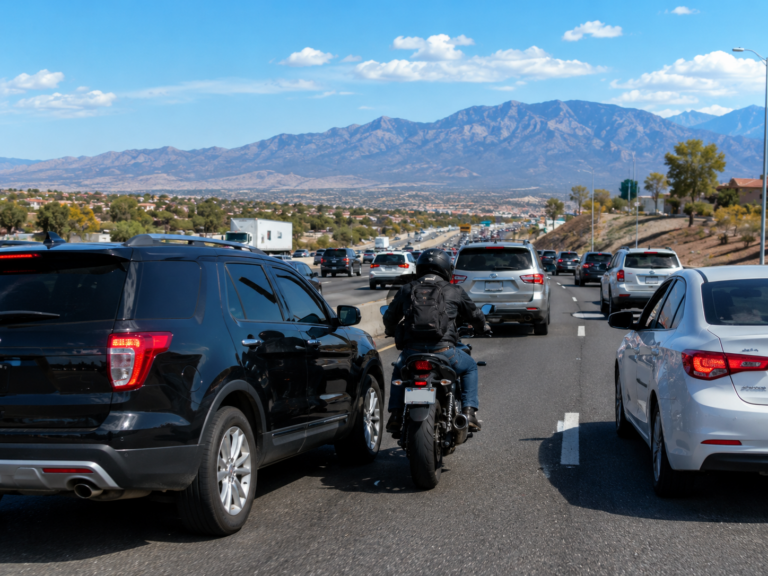
If you ride a motorcycle in New Mexico, you have probably wondered whether the New Mexico lane splitting law lets you slip between stopped cars to beat a backup on I-25 or asked it more plainly: is lane splitting legal in New Mexico? Lane splitting that leads to an accident can shape everything about a crash claim if you are hurt, which is why the Albuquerque motorcycle accident lawyers at Lerner and Rowe hear this question so often.
In this blog, we break down what the law actually says, how riding between lanes affects fault after a collision, whether you can still recover compensation if you were splitting lanes, and the crash scenarios and injuries riders see most often.
Is Lane Splitting Legal in New Mexico?
No. Lane splitting is not legal anywhere in New Mexico, and neither is lane filtering at low speeds or stoplights. New Mexico traffic law requires every vehicle, motorcycles included, to stay within a single marked lane and to move over only after making sure it is safe, under NMSA 1978, Section 66-7-317. On top of that, cities across the state adopt the New Mexico Uniform Traffic Ordinance, whose motorcycle provision is explicit: a rider may not overtake another vehicle in the same lane and may not operate between lanes of traffic or between rows of stopped vehicles.
It helps to separate three terms that often get confused. Lane splitting means riding the painted line between two lanes of same-direction traffic, moving or stopped. Filtering is the slower version, usually creeping between stopped cars at a red light. Both are illegal here, and there is no filtering motorcycle New Mexico exception that carves out slow, stop-and-go traffic. Lane sharing, where two motorcycles ride side by side in one lane, is legal in New Mexico. The only exception to the law includes a police motorcycle officer performing official duties.
The law requires riders to make full use of a single lane and stay in it unless it is safe to move over and pass. If you do pass, you cross fully into the adjacent lane, signal, and check your blind spot before returning. Violating the rule is a moving violation that carries a fine, and it can follow you into a civil case if a crash results. Our Albuquerque personal injury attorneys see how quickly that plays out after a wreck.
How the New Mexico Lane Splitting Law Affects Fault after a Crash
After a motorcycle accident, Albuquerque riders quickly discover how illegality becomes expensive. When a rider is splitting lanes at the moment of impact, the other driver’s insurer will almost always argue that the rider caused or contributed to the wreck simply by being where the law says they should not be. Breaking a traffic law is treated as evidence of negligence, which gives the insurance company a ready-made argument to shift blame onto you.
That does not mean the driver is not responsible. A car that merges without looking, opens a door into traffic, or was speeding still bears responsibility for its own careless conduct, whether the other vehicle was a passenger car or a commercial truck. Fault in these cases is rarely all or nothing, and how it is divided determines how much you can recover.
Recovering Compensation Despite the New Mexico Lane Splitting Law
The good news is that a lane-splitting violation does not automatically bar you from a claim. New Mexico follows a pure comparative negligence rule, which means your compensation is reduced by your percentage of fault but never eliminated because of it. Even a rider found mostly responsible can still recover something.
For example, if your damages total $100,000 and you are assigned 40 percent of the blame for splitting lanes, you can still collect $60,000. Because the reduction is proportional, the number an insurer tries to pin on you directly affects your check, which is exactly why these cases are worth fighting. A motorcycle injury claim New Mexico riders bring after a lane splitting crash is rarely hopeless, even with a citation on record. In the most tragic collisions, families may also have grounds for a wrongful death claim even when lane splitting was involved.
Common Wrecks Tied to the New Mexico Lane Splitting Law
A lane splitting motorcycle accident New Mexico riders get caught in usually traces back to one of a few patterns. Because Albuquerque riders are squeezed into space that drivers do not expect them to occupy, these come up again and again:
- Merging vehicles: A driver changes lanes to fill a gap, never checking for a motorcycle threading the line, and clips the rider mid-pass.
- Sudden stops: Traffic lurches to a halt and a rider filtering forward has nowhere to go, rear-ending a stopped bumper or getting pinned between vehicles.
- Dooring: In slow city traffic, a passenger opens a door into the lane gap, leaving a rider no time to react. It is one of the reasons lane splitting turns ordinary car accidents into far more serious motorcycle wrecks.
These collisions tend to happen at low speed but still cause serious harm because a rider has no crumple zone and little room to react.
Common Injuries in a Lane Splitting Accident
Motorcyclists, much like people injured in pedestrian accidents, have almost no protection between their body and the road, which is why it is important for riders to wear full protective gear. Even a low-speed lane splitting collision can leave a rider with:
- Road rash
- Broken bones
- Abrasions
- Traumatic brain injuries, even with a helmet
- Spinal cord damage
- Catastrophic injuries
Injuries like these often mean surgery, lost income, and a long recovery. An experienced New Mexico injury attorney can help you pursue the compensation you need to cover medical bills, lost wages, and the other losses that pile up after a serious crash.
Talk to Our Albuquerque Motorcycle Accident Lawyers
A lane splitting citation is not the end of your claim, and you should not let an insurance adjuster convince you otherwise. Our team is available 24/7 to review what happened and explain your options.
We have recovered billions of dollars for injured clients nationwide, and with no fees unless we win, you have nothing to lose and everything to gain.
To schedule a free case review, call (505) 444-4444, reach us through LiveChat, or complete our online contact form.
The information on this blog is for general information purposes only. Nothing herein should be taken as legal advice for any individual case or situation. This information is not intended to create, and receipt or viewing does not constitute, an attorney-client relationship.