



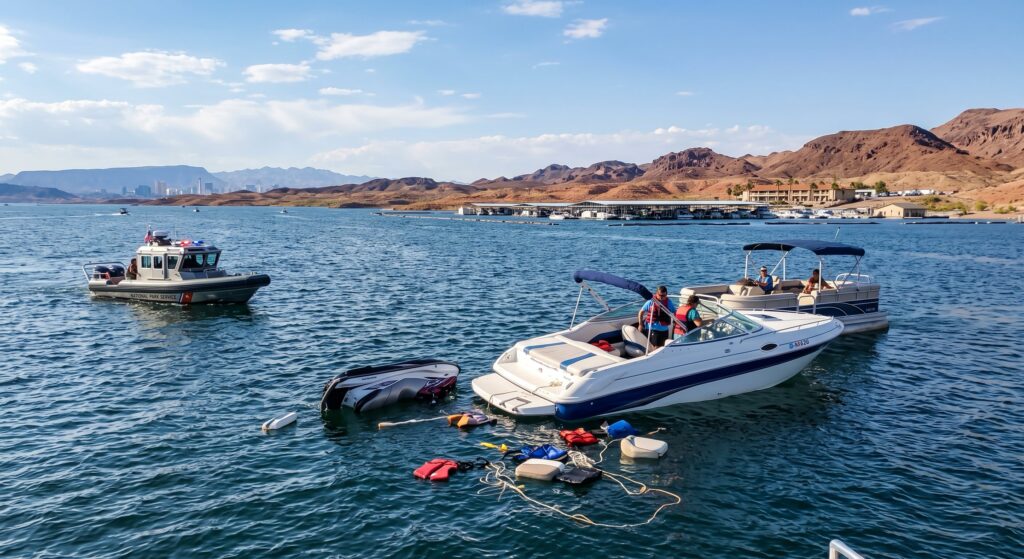
Late August brings the year’s heaviest recreational boating traffic to Lake Mead National Recreation Area, as Southern Nevada residents and summer tourists converge on the water for one final push before the season ends. Lake Mead summer boating injuries spike during this window as heat exhaustion, alcohol consumption, and inexperienced operators combine with rising late-summer boat traffic. If a negligent operator caused your crash, a Las Vegas boat accident lawyer from Lerner and Rowe can investigate what happened and fight for the full compensation you deserve.
Boating injury claims in Nevada involve federal maritime law, National Park Service (NPS) regulations, and Nevada state negligence law simultaneously. The liability picture is more complex than a standard car accident claim, and the evidence window is shorter. Lerner and Rowe’s accomplished Las Vegas injury attorneys handle these claims regularly and know exactly how to build a case from the documentation available on Lake Mead.
The Risk of Lake Mead Summer Boating Injuries
Lake Mead summer boating injuries reflect a specific mix of hazards that makes August one of the most dangerous months on the water. The reservoir’s surface temperature reaches the mid-80s, which accelerates heat illness in operators who may have been on the water for hours without adequate fluid intake. A dehydrated operator’s cognitive function and reaction time degrade in ways that closely parallel the impairment produced by alcohol, and when alcohol is also present, the combined effect is severe.
The Las Vegas Boat Harbor at Hemenway Harbor and the Lake Mead Marina at Boulder Beach both see their highest boat traffic volumes of the year during late August weekend afternoons. The convergence of rental watercraft, personal watercraft, wake boats, and smaller fishing vessels in the same areas creates exactly the traffic density where operator inattention produces collisions.
Boating Under the Influence in Clark County, Nevada
Boating under the influence in Clark County, Nevada is a criminal offense under NRS 488.410, and it carries the same 0.08 percent blood alcohol content threshold as driving under the influence on land. The National Park Service and Clark County Sheriff’s marine patrol units actively enforce BUI on Lake Mead during peak summer weekends, particularly in the Hemenway Harbor and Boulder Beach areas where boat traffic is most concentrated. A BUI finding in a criminal proceeding is admissible evidence in a civil injury claim against the impaired operator.
Rental boat operators are not exempt from BUI enforcement. Companies that rent watercraft to operators who present signs of impairment face their own independent liability exposure. Lerner and Rowe examines the rental company’s checkout process in every BUI-related boating injury claim to determine whether the company’s negligence in renting to an impaired operator supports a direct claim alongside the operator liability case.
Weather and Lake Mead Summer Boating Injuries
August monsoon weather produces rapid, unpredictable lake conditions that catch inexperienced boaters off guard. What begins as a calm afternoon can become whitecap conditions within 30 minutes when a late-summer storm system moves through the Lake Mead basin. Operators who are not monitoring weather alerts and who have positioned themselves far from a safe harbor when conditions deteriorate face a dangerous return that inexperience makes more hazardous.
NPS regulations require operators to keep a proper lookout and to reduce speed in deteriorating conditions. An operator who continues at wake-producing speed when whitecap conditions have developed, or who fails to reduce speed near shore when wind-driven waves are pushing other vessels unpredictably, has violated those standards. Those violations are the legal foundation of a negligence claim when they cause a collision or contribute to an injury.
Boat Collision on Lake Mead in August
A boat collision on Lake Mead in August typically involves one of two scenarios: a collision between two vessels in high-traffic areas near marina access channels and designated swimming zones, or a vessel striking a swimmer or personal watercraft operator in a no-wake zone that was being violated. Both types of collisions produce severe injuries because water provides no cushioning on impact and because occupants of open boats and personal watercraft have no structural protection.
U.S. Coast Guard and NPS ranger reports document collision locations, vessel identification, operator information, and any evidence of BUI or speed violations. Those reports are the primary evidentiary foundation of a boating injury claim, and Lerner and Rowe obtains them immediately after being retained.
Liability in Lake Mead Summer Boating Injuries
Boating accidents in Clark County, Nevada may involve liability from the at-fault operator, the vessel owner, if different from the operator; a rental company whose negligence in maintaining or renting the vessel contributed to the crash; or the NPS if a maintenance failure on a dock or launch ramp created a hazard. Lerner and Rowe’s skilled Las Vegas boat accident lawyers identify every liable party from the start and pursue all of them simultaneously.
Nevada’s modified comparative fault system applies to boating injury claims on Lake Mead. You can recover damages as long as you are not found more than 50 percent responsible for the crash. In a collision caused by a BUI operator or a speed violation in a no-wake zone, the at-fault operator’s fault percentage is typically very high, and the injured party’s recovery is correspondingly strong.
Personal Watercraft Crashes Near Las Vegas, Nevada
Many Nevada residents and visitors enjoy a personal watercraft (PWC) ride on Lake Las Vegas. PWCs are often referred to by brand name, such as Kawasaki’s Jet Ski or Yamaha’s Waverunner. A Jet Ski crash near Las Vegas, Nevada on Lake Mead is among the most dangerous boating injury scenarios our attorneys handle because PWC riders have no surrounding structure to absorb a collision.
Personal watercraft rental operators at Lake Mead are required to provide safety instructions and ensure renters understand the applicable rules before they take the machine out. A rental company that releases a Jet Ski to an operator who has not completed the required orientation, or that rents to a minor without the required adult supervision, has created independent liability exposure that extends beyond the individual operator.
Drowning and Lake Mead Summer Boating Injuries
Drowning is the most severe outcome of Lake Mead summer boating injuries and accounts for a significant share of August boating fatalities at the recreation area. Most drowning victims at Lake Mead were not wearing life jackets at the time of the incident — a decision that is legal for adults but that dramatically reduces survival odds when an operator is knocked into the water by a collision or a sudden wave.
When a drowning results from another operator’s negligence — a vessel that struck the victim’s boat at speed, a wake that capsized a smaller vessel in a no-wake zone, or a BUI operator who caused the crash — the victim’s family has a viable wrongful death claim regardless of the victim’s life jacket status. Nevada’s modified comparative fault system may reduce the recovery if the victim’s own decisions contributed to the outcome, but it does not eliminate the negligent operator’s liability.
Seeking Compensation for a Boat Accident in Nevada
Seeking compensation for a boat accident in Nevada requires building a demand that reflects the full cost of the injury. Recoverable damages include emergency medical treatment, surgery for broken bones and lacerations, rehabilitation for brain injuries sustained in the collision, lost wages, loss of future earning capacity, and pain and suffering. In cases involving catastrophic injuries or wrongful death, life care planning accounts for decades of future costs the settlement must reflect.
Handling Lake Mead Summer Boating Injuries
After any boating injury on Lake Mead, call the NPS ranger station or U.S. Coast Guard immediately. A federal incident report documents the crash conditions, vessel information, and any evidence of violations before the scene disperses. Seek medical attention the same day — brain injuries and internal injuries from boating collisions frequently have delayed symptom onset. Do not give recorded statements to any insurance representative before speaking with an attorney.
Lerner and Rowe has secured billion-dollar results for injury victims across the nation. Nevada’s statute of limitations for personal injury claims is two years from the date of the crash under NRS 11.190. Contact our team as soon as possible so evidence preservation begins immediately. And don’t forget that you pay nothing unless we win thanks to our “No Fee Promise.”
A Las Vegas Boat Accident Lawyer Protects Your Rights
A Las Vegas boat accident lawyer from Lerner and Rowe handles every element of your claim — federal incident report requests, rental company record subpoenas, BUI documentation, and medical expert coordination. Our attorneys know the specific evidentiary framework of Lake Mead boating injury claims and know how to build the case that holds every negligent party accountable. Call us to schedule your free, no-obligation consultation.
Call a Las Vegas Boat Accident Lawyer Near Me
The Las Vegas personal injury attorneys at Lerner and Rowe are available 24 hours a day, 7 days a week. Our team handles Lake Mead summer boating injuries, BUI collision claims, and complex multi-party boating liability cases every day. You can trust our distinguished Las Vegas boat accident lawyer team to fight to win you the full and fair settlement you’re entitled to under Nevada law.
Call Lerner and Rowe today and take your first step towards justice. Our team is available by phone at (702) 877-1500. If you prefer to connect with us online, you can reach us through our LiveChat agents or submit your case details through our encrypted contact form.
The information on this blog is for general information purposes only. Nothing herein should be taken as legal advice for any individual case or situation. This information is not intended to create, and receipt or viewing does not constitute, an attorney-client relationship.