



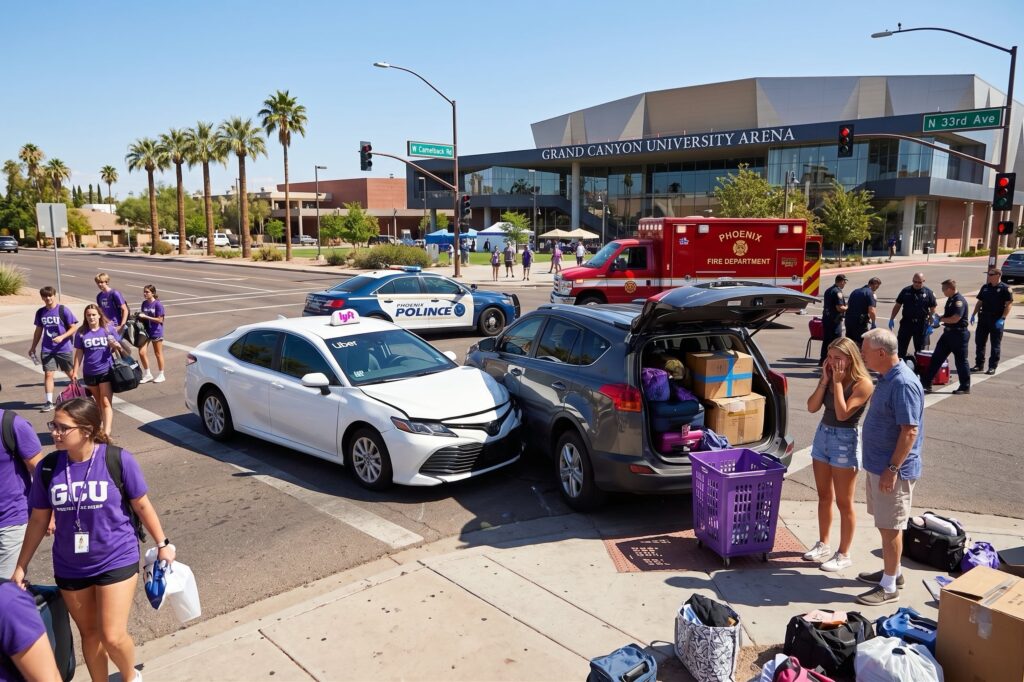
Late August brings thousands of students and families to Phoenix for move-in week at Grand Canyon University and ASU’s Downtown Phoenix campus, driving a massive surge in Uber and Lyft trips across the city. College move-in rideshare crashes spike during this window as unfamiliar drivers navigate congested campus corridors while monitoring apps and GPS screens. A Phoenix rideshare accident attorney from Lerner and Rowe can cut through the complex insurance structure that governs these claims and fight for the full compensation you deserve.
Rideshare crash claims are more legally complex than standard car accident claims. Uber and Lyft structure their insurance in tiers based on the driver’s app status, and the companies move quickly to minimize their liability after a crash. Lerner and Rowe’s proven injury attorneys are familiar with every version of that structure and know how to challenge it.
Risks of College Move-In Rideshare Crashes
College move-in rideshare crashes in Phoenix during August originate from a specific combination of conditions: unfamiliar drivers, congested campus corridors, families loading and unloading on active streets, and the financial pressure of surge pricing that pushes drivers to complete fares faster than road conditions allow. Campus move-in zones are not designed for the volume of rideshare traffic that August generates, and the results are predictable.
Drivers who are new to the GCU and ASU Downtown Phoenix corridors rely heavily on GPS navigation, which requires active screen interaction while driving. A driver who accepts a new ride request while navigating a congested campus block has divided their attention between the app, the navigation, and the road — a documented pattern in rideshare crash investigations across Maricopa County.
Uber Crash Near GCU in Phoenix, Arizona
An Uber crash near GCU in Phoenix, Arizona during move-in week typically involves the Camelback Road and 27th Avenue corridor that borders the campus. Rideshare vehicles double-parking in active travel lanes, executing U-turns on Camelback to reach specific building entrances, and stopping without warning in the flow of traffic create rear-end and sideswipe scenarios that affect not just Uber passengers but every vehicle in the vicinity. The GCU Arena district on 35th Avenue generates additional event-night rideshare surges that compound the move-in week traffic pattern.
App activity logs from the Uber platform document whether the driver had an active ride at the time of the crash, what their GPS destination was, and whether they were interacting with the app in the seconds before impact. Lerner and Rowe requests those records immediately after being retained.
Lyft Accident Near ASU Downtown Phoenix, Arizona
A Lyft accident near ASU Downtown Phoenix, Arizona during move-in week concentrates on the Central Avenue and Taylor Street corridors that run through the university’s downtown campus. The university buildings generate heavy pedestrian crossings at exactly the hours when Lyft surge pricing produces aggressive driver behavior in the area.
Lyft drivers who are positioning themselves to capture surge fares from students arrive in the corridor at speed and look for parking-adjacent stopping points that put them in active travel lanes.
When a Lyft crash injures a passenger who was being transported to the ASU downtown campus, Lyft’s $1 million commercial liability policy applies. When it injures a pedestrian, cyclist, or motorist in the vicinity, the applicable tier depends on the driver’s app status at the moment of impact — a determination that Lerner and Rowe makes from the platform’s own activity logs, not from the driver’s self-reporting.
Causes of College Move-In Rideshare Crashes
The causes of college move-in rideshare crashes in Phoenix during August follow a consistent pattern that our Phoenix rideshare accident attorneys identify in every Maricopa County investigation.
- App distraction: Accepting new ride requests, confirming passenger details, and navigating to pickup pins while driving are the primary cause of distracted driving rideshare crashes in dense move-in corridors.
- Illegal stopping in travel lanes: Rideshare drivers who cannot find a legal stopping point near a campus building pull over in active travel lanes, forcing other vehicles to change lanes suddenly and creating rear-end crash risk for following drivers.
- Aggressive positioning for surge fares: Financial incentive pushes drivers toward move-in corridors faster than traffic conditions allow, producing the speeding and aggressive lane-change behavior that causes sideswipe crashes.
- Unfamiliarity with Phoenix campus roads: Out-of-state and new drivers who rely entirely on GPS navigation miss last-second turns, execute U-turns on multi-lane roads, and make sudden braking decisions that give following drivers no stopping distance.
- Passenger loading conflicts: Multiple rideshare vehicles converging on the same campus building entrance simultaneously produce vehicle conflicts in the loading zone that spill into the adjacent travel lane.
Phoenix Sky Harbor Airport Rideshare Crash
A Phoenix Sky Harbor airport rideshare crash during college move-in week involves a specific traffic dynamic: thousands of out-of-state families flying into Phoenix Sky Harbor International Airport and immediately requesting Uber or Lyft rides to campus housing.
Drivers who pick up at Terminal 3 or Terminal 4 and immediately enter the I-10 interchange face a rapid transition from airport surface roads to freeway merging — a scenario where GPS-following, luggage-managing, and unfamiliar lane geometry combine to produce the abrupt lane changes and sudden stops that cause crashes in the first miles of the ride.
The airport rideshare pick-up area is one of the highest-density crash environments in Phoenix during move-in week. Lerner and Rowe requests the airport’s own surveillance footage from the rideshare staging area alongside Uber and Lyft app activity records in every Sky Harbor rideshare crash investigation.
College Move-In Rideshare Crashes Liability
Liability in college move-in rideshare crashes in Phoenix may rest with the driver personally, with Uber or Lyft depending on the driver’s app status, or with a third-party driver whose actions contributed to the crash. Arizona’s pure comparative fault system means you can recover damages proportional to the other party’s fault — your recovery is reduced by your percentage of responsibility, but never eliminated entirely. Lerner and Rowe’s skilled Phoenix rideshare accident attorney team documents every contributing act of negligence from the start.
When a rideshare vehicle causes a crash that injures someone other than the passenger — a pedestrian, a cyclist, or an adjacent motorist — the applicable coverage tier depends on whether the driver had an active ride at the time. Lerner and Rowe resolves that question with the app data, not with the driver’s account of events.
How Uber and Lyft App Status Affects Coverage
Uber and Lyft both structure their Arizona liability coverage in three tiers. When the app is off, only the driver’s personal auto insurance applies. When the app is on and the driver is waiting for a request, a contingent policy of approximately $50,000 per person applies — significantly lower than most victims expect.
Once a ride is accepted and through the completion of the trip, the full $1 million commercial policy is active. The tier that applies to your crash determines both which insurer handles the claim and how much coverage is available.
Rideshare companies know that tier disputes are where claims break down. A driver who claims they had not yet accepted a ride when the crash occurred shifts the applicable coverage from $1 million to $50,000. Lerner and Rowe obtains the app activity log that shows exactly when the ride was accepted and uses it to establish which tier — and which policy limit — governs your claim.
College Move-In Rideshare Crashes Injuries
College move-in rideshare crashes in Phoenix produce injuries that range from soft tissue damage in lower-speed campus corridor crashes to severe outcomes when freeway-speed collisions are involved. Passengers in rideshare vehicles who are not braced for a sudden impact — common in distracted-driver rear-end crashes — absorb the collision force without warning. Broken bones, particularly to the wrist, shoulder, and collarbone from bracing, and brain injuries from head strikes against windows and door pillars, are among the most common outcomes.
In higher-speed crashes — particularly those originating in the Sky Harbor airport rideshare zone or on I-10 during the freeway portion of a campus ride — catastrophic injuries and wrongful death are outcomes Lerner and Rowe has helped Phoenix families navigate.
A same-day medical evaluation after any rideshare crash is critical — brain injuries and internal injuries frequently present delayed symptoms that need to be documented before any gap appears in the medical record.
Dangerous Intersections Along Camelback and Central
The intersections along Camelback Road between 24th Street and 35th Avenue and along Central Avenue through the downtown corridor produce the highest concentration of college move-in rideshare crashes in Phoenix during August. These are the blocks where GCU student housing, ASU Downtown campus buildings, and Midtown apartment complexes all generate simultaneous rideshare pickup and dropoff activity during move-in week.
Traffic camera data from the city’s intersection network covers both corridors and documents vehicle behavior, signal states, and approximate speeds at the time of any crash. That footage is retained on rolling schedules of 30 days or less. Lerner and Rowe sends preservation demands to the City of Phoenix on the day we are retained — not after the window has closed.
Damages for College Move-In Rideshare Crashes
Recoverable damages in a college move-in rideshare crash claim include emergency medical treatment, surgery and hospitalization, physical therapy and rehabilitation, lost wages or lost academic time during recovery, loss of future earning capacity if the injury is permanent, and pain and suffering. In cases involving catastrophic injury or wrongful death, life care planning accounts for future costs the settlement must reflect in full.
Seeking Compensation for a Rideshare Accident in Arizona
Seeking compensation for a rideshare accident in Arizona requires resolving the tier dispute before any demand can be made — the applicable coverage limit defines the ceiling of the recovery. Lerner and Rowe obtains the app activity log, confirms the applicable tier, and then builds the demand that reflects every element of the injury against the correct policy. Arizona’s statute of limitations for personal injury claims is two years from the date of the crash under ARS 12-542.
College Move-In Rideshare Crashes Legal Help
Lerner and Rowe handles college move-in rideshare crashes, Uber and Lyft insurance tier disputes, and complex multi-party injury cases across Maricopa County every day. Our Phoenix rideshare accident attorney team pursues app activity logs, airport surveillance footage, and traffic camera records on the same day we are retained — so no evidence disappears before your case is built. And don’t forget, you pay nothing unless we win thanks to our “No Fee Promise.”
Call a Trusted Phoenix Rideshare Accident Lawyer
Lerner and Rowe has recovered billions for injury victims across the country. Our attorneys know what a serious college move-in rideshare crash claim is actually worth and will not accept a settlement that falls short. Call us today to schedule your free, no-obligation consultation. We’re available by phone at any time.
Contact a Phoenix Rideshare Accident Attorney Today
The Phoenix personal injury attorneys at Lerner and Rowe are available 24 hours a day, 7 days a week. Our team handles college move-in rideshare crashes, Uber and Lyft liability disputes, and complex multi-party injury cases every day. You can trust our distinguished Phoenix rideshare accident attorney team to fight for the highest compensation allowed under Arizona law while you focus on your recovery.
Call us today to schedule your free consultation. You can also reach us online through our LiveChat representatives or by submitting your case details through our encrypted contact form.
The information on this blog is for general information purposes only. Nothing herein should be taken as legal advice for any individual case or situation. This information is not intended to create, and receipt or viewing does not constitute, an attorney-client relationship.