


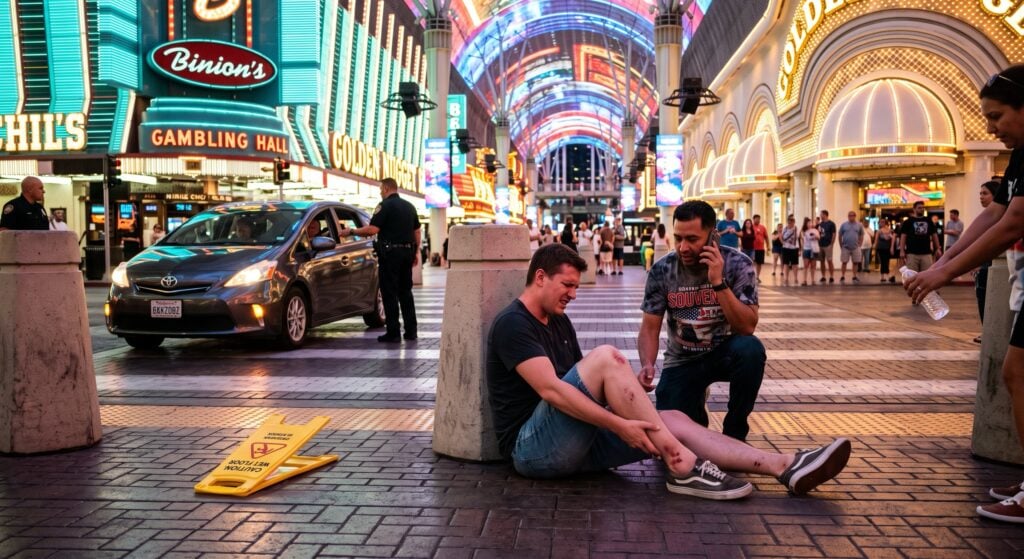
Triple-digit August heat pushes Las Vegas foot traffic almost entirely into the nighttime hours, and nowhere feels that shift more intensely than the blocks surrounding the Fremont Street Experience. When late-summer concert crowds spill off the covered canopy onto Carson Avenue, Ogden Avenue, and 4th Street, they meet drivers — rideshare vehicles, delivery vans, and bar-hoppers — who are navigating narrow downtown corridors at night with limited attention. Fremont Street nighttime pedestrian accidents in this environment happen fast and cause serious injuries. A Las Vegas pedestrian injury attorney from Lerner and Rowe can investigate your crash and fight for the full compensation you deserve.
Pedestrian crash claims in Downtown Las Vegas involve a specific mix of legal issues, including Nevada right-of-way law, premises liability where inadequate lighting contributed, and insurer arguments that a pedestrian who was out late bears shared fault. Lerner and Rowe’s skilled Nevada injury attorneys know every version of those arguments and know how to counter them.
The Risk of Fremont Street Nighttime Pedestrian Crashes
The Fremont Street area is at its most congested between 9:00 p.m. and 2:00 a.m. during August. The Downtown Las Vegas Arts District and First Friday draw thousands of additional pedestrians into the blocks south of Fremont Street, where street lighting is less consistent than on the main Fremont corridor and where the mix of through-traffic and parking lot exits creates multiple vehicle-pedestrian conflict points per block. Rideshare vehicles double-parking to drop off and pick up passengers add a specific hazard: pedestrians stepping around stopped rideshare cars into active travel lanes.
Fremont Street nighttime pedestrian accidents in this zone are not random events. They follow predictable patterns — peak demand for rides and deliveries at exactly the hours when foot traffic is highest and street lighting is least adequate. The collision risk is highest not on the Fremont Street canopy itself, where pedestrian-only zones are maintained, but on the surrounding side streets where normal vehicle traffic resumes with little warning to pedestrians who have just left the car-free zone.
Crosswalk Injuries Along Carson Avenue in Downtown Las Vegas
Crosswalk injuries along Carson Avenue in Downtown Las Vegas occur with particular frequency at the intersections closest to Fremont Street — where crowds crossing between the Experience and the surrounding bars and restaurants create high-volume pedestrian crossings that drivers frequently roll through at partial stops.
The combination of signalized intersections with short pedestrian crossing windows and impatient drivers who are looking for gaps in traffic rather than watching for crossing pedestrians produces the vehicle-pedestrian contacts that our Las Vegas pedestrian injury attorneys handle regularly from this corridor.
Nevada law requires drivers to yield to pedestrians at all marked crosswalks and at unmarked crosswalks at intersections. A driver who fails to yield at a Carson Avenue crossing and strikes a pedestrian legally in the crosswalk has violated that law, and under Nevada’s negligence per se doctrine, that violation is direct evidence of fault in a civil injury claim. The pedestrian’s time of night is not a defense — the legal obligation applies at all hours.
Liability for a Fremont Street Nighttime Pedestrian Crash
Nevada’s modified comparative fault system means a pedestrian can recover damages from a Fremont Street nighttime pedestrian crash as long as they are not found more than 50 percent responsible for the collision. The at-fault driver’s insurer will argue that a pedestrian who was walking late at night, possibly near an entertainment venue, contributed to their own injury.
Lerner and Rowe’s experienced Las Vegas injury attorneys build the evidence record — the crosswalk markings, the signal state, the driver’s speed, and any available camera footage — that establishes fault where the law places it.
When inadequate street lighting contributed to the crash, the City of Las Vegas or a venue property manager may share liability alongside the driver. A city that has received prior complaints about unlit crosswalks in the downtown entertainment district and has not addressed them has constructive notice of the hazard — and that notice creates governmental liability exposure. Lerner and Rowe investigates every potential liable party from day one.
Distracted Driver Pedestrian Collisions
Distracted driver pedestrian collisions in the Fremont Street area follow a specific pattern: a rideshare or delivery driver who is monitoring their app for the next fare or confirming a pickup address at exactly the moment they should be watching for pedestrians in a crosswalk.
The vehicle moves through the intersection or along the block without the driver ever processing that someone is in their path. The results range from soft tissue impacts when the driver brakes partially to direct strikes that cause severe injuries.
Phone records and rideshare app activity logs can establish that a driver was interacting with a platform at the moment of impact. Lerner and Rowe requests those records through formal legal channels immediately after being retained — the data that proves a driver was accepting a new Uber request when they struck a pedestrian is exactly what the platform and the insurer will resist disclosing.
Injuries From Fremont Street Nighttime Pedestrian Crashes
Pedestrians struck by vehicles in the Fremont Street area absorb the full force of the impact without protection. Even at the relatively low speeds of downtown driving, a vehicle strike can produce devastating injuries. Soft tissue damage to muscles, tendons, and ligaments — particularly in the back, neck, and shoulders — is among the most common outcomes of lower-speed pedestrian impacts and frequently becomes a chronic pain condition that outlasts the initial treatment window.
In higher-speed impacts, broken bones — particularly to the femur, pelvis, and wrist — require surgery and months of rehabilitation. Brain injuries from head strikes against the vehicle or pavement are genuine risks that may not produce obvious symptoms at the scene. Getting a same-day medical evaluation is the single most important step an injured pedestrian can take — it creates the baseline record that connects symptoms to the crash before any gap appears.
Pedestrian Hit by a Car Near Fremont Street
A pedestrian hit by a car near Fremont Street faces a recovery that is complicated by the downtown environment itself. Multiple cameras — venue security systems, city traffic cameras, and dashcams from nearby vehicles — may have captured the crash. Those systems operate on rolling retention schedules of 24 to 72 hours in many cases.
Lerner and Rowe sends preservation letters to the City of Las Vegas traffic management department, to the venue operators with exterior cameras, and to the rideshare or delivery platform if a company vehicle was involved — all within 24 hours of being retained.
The physical car crash scene in Downtown Las Vegas also changes quickly. Skid marks are erased by subsequent traffic. Debris is cleared by overnight street cleaning. The pedestrian signal timing and crosswalk configuration at the intersection can be altered by the city’s traffic management system within days of the crash. Lerner and Rowe documents the scene conditions with photographs and independent measurements before those changes occur.
Insurance and Fremont Street Nighttime Pedestrian Claims
Insurance claims from Fremont Street nighttime pedestrian accidents frequently involve disputes about whether the driver’s personal auto policy or a rideshare platform’s commercial policy governs coverage. Lerner and Rowe determines the applicable policy from the rideshare app’s activity log, which documents whether the driver had an active ride at the time of the crash. That determination can mean the difference between a $50,000 personal policy and a $1 million commercial policy.
Deceptive insurance agents use tactics to minimize pedestrian injury claims in entertainment districts are well-documented: arguing that the pedestrian was intoxicated, was not using a marked crosswalk, or was wearing dark clothing that reduced their visibility. Lerner and Rowe counters every one of those arguments with the evidence — Nevada law’s absolute crosswalk yield requirement applies regardless of a pedestrian’s condition or clothing.
Seeking Compensation for a Pedestrian Accident in Clark County, Nevada
Seeking compensation for a pedestrian accident in Clark County, Nevada requires a demand that reflects the full cost of the injury — not just the immediate ER visit. Recoverable damages include emergency medical treatment, surgery and hospitalization, physical therapy for soft tissue injuries and broken bones, ongoing neurological care for brain injuries, lost wages during recovery, loss of future earning capacity, and pain and suffering. Lerner and Rowe builds the demand from the documented evidence and will not accept a settlement that falls short of the full value of your claim.
Handling a Fremont Street Nighttime Pedestrian Accident
What you do immediately after a Fremont Street nighttime pedestrian accident determines how strong your eventual claim will be. The first priority is safety and medical attention. After that, the evidence gathering clock starts immediately.
- Call 911: A Las Vegas Metropolitan Police Department report documents road conditions, crosswalk status, and witness information before the scene clears.
- Photograph everything before you move: The vehicle, your position in the crosswalk or street, nearby signage, and your injuries. Wide shots showing the intersection context are especially important.
- Collect witness contact information: Downtown crowds disperse fast. Get names and contact details from anyone who saw the crash before they walk away.
- Get a same-day medical evaluation: Brain injuries and internal injuries may not produce obvious symptoms at the scene. A same-day record connects your condition to the crash before any gap appears.
- Do not give recorded statements: The at-fault driver’s insurer may contact you within hours. Decline any recorded statement until you have spoken with a Las Vegas pedestrian injury lawyer from Lerner and Rowe.
A Las Vegas Pedestrian Injury Lawyer Fights for You
A Las Vegas pedestrian injury lawyer from Lerner and Rowe handles every element of your claim from the moment you call. We issue preservation demands to the city, the venues, and the relevant platforms. We identify and contact witnesses. We obtain the medical records that document your injuries in the specific detail that withstands insurer challenges. We handle all communication with the at-fault driver’s carrier so you are not managing a complex legal process while trying to recover.
Lerner and Rowe understands that you have many options when it comes to choosing a Las Vegas personal injury lawyer. Our lawyers have a proven track record of success and have recovered billions for injury victims across the country. And don’t forget that you pay nothing unless we win thanks to our “No Fee Promise.” With nothing to lose and everything to gain, you owe it to yourself to reach out to us today.
Call a Las Vegas Pedestrian Injury Lawyer Near Me
The Las Vegas personal injury attorneys at Lerner and Rowe are available 24 hours a day, 7 days a week. Our team handles Fremont Street nighttime pedestrian accidents, downtown crosswalk crash claims, and complex insurance disputes every day. You can trust our distinguished Las Vegas pedestrian injury attorney team to fight for the highest compensation allowed under Nevada law while you focus on your recovery.
Call Lerner and Rowe today to schedule your free, no-obligation consultation. We’re available by phone at (702) 877-1500. You can also reach us online through our LiveChat representatives or by submitting your case details through our encrypted contact form.
The information on this blog is for general information purposes only. Nothing herein should be taken as legal advice for any individual case or situation. This information is not intended to create, and receipt or viewing does not constitute, an attorney-client relationship.