



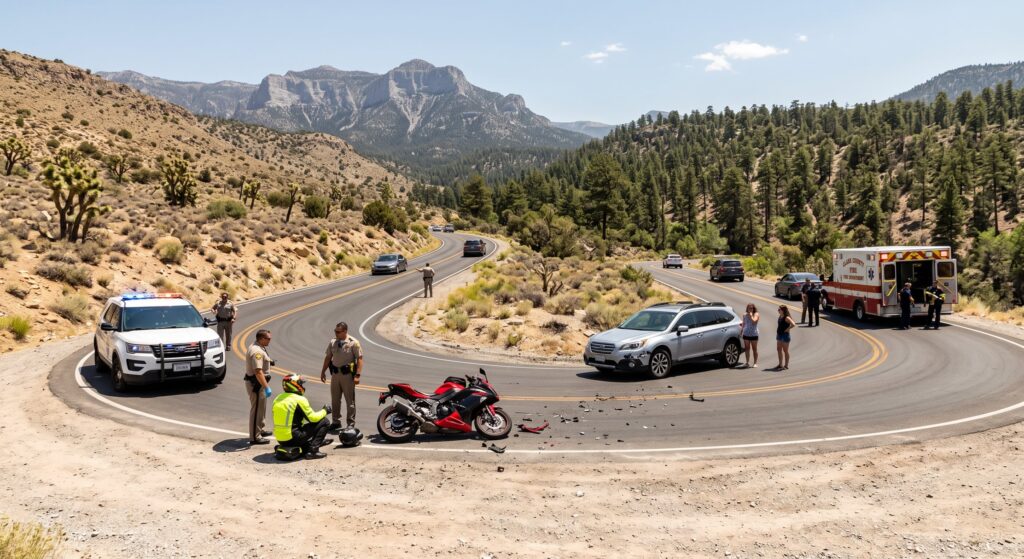
When Las Vegas Valley temperatures hit 110 degrees in July, local riders head for the mountain. The Kyle Canyon Road climb to Mount Charleston drops temperatures by 30 degrees or more and offers some of the most technically satisfying riding in Southern Nevada. It also puts motorcyclists on narrow mountain roads with out-of-town tourists in rental cars who have never navigated a tight two-lane switchback. Mount Charleston motorcycle crashes surge every summer as that combination produces blind-corner collisions, head-on drift crashes, and sudden-brake rear-ends that leave riders with serious injuries. A Las Vegas motorcycle injury lawyer from Lerner and Rowe can investigate your crash and fight for every dollar you are owed.
Insurance companies treat motorcycle injury claims differently from car accident claims — and not in the rider’s favor. The anti-biker bias that adjusters bring to these cases is real and documented, and countering it requires an attorney who has seen every version of it. Lerner and Rowe’s accomplished Las Vegas motorcycle injury lawyers know how to fight in order to win you the full and fair compensation that you deserve.
Escaping the Las Vegas Summer Heat
Kyle Canyon Road is the primary route to the Spring Mountains National Recreation Area and Mount Charleston Village, and it carries a dramatically different traffic mix on a hot July weekend than on a cool October morning. Summer tourist traffic fills the road with rental cars, camper vans, and out-of-state drivers looking at their phones for trail maps rather than watching the road ahead. Motorcyclists who know every curve of this road face hazards created by people who have never driven it before.
The Mount Charleston Lodge and the Spring Mountains Visitor Gateway are popular summer destinations that generate significant parking lot entry and exit traffic at blind points along the road. Riders who are navigating a curve at 35 mph when a driver pulls out of a parking lot without looking have no margin for error and no structural protection between them and the outcome.
The Risk of a Motorcycle Crash in Las Vegas, NV
A motorcycle crash in Las Vegas, NV in the mountain corridor does not always involve a collision with another vehicle. Road hazards that passenger car drivers roll over without noticing — gravel washed across a curve from a recent storm, a pothole at the apex of a turn, a patch of shade-damp asphalt — can send a motorcycle down in seconds. When those hazards result from the failure of a government entity or a property owner to maintain the road, the claim extends beyond the driver who hit you.
The descent from Mount Charleston back toward the valley also carries specific risks. Brakes that overheat on a sustained downhill grade, sunset glare hitting westbound riders directly in the visor, and fatigued drivers losing concentration after a long day at altitude all contribute to the crash pattern our Las Vegas motorcycle injury lawyer team sees regularly in summer mountain claims.
Mount Charleston Motorcycle Crashes Explained
Mount Charleston motorcycle crashes tend to cluster around a consistent set of road and driver behaviors. Understanding which pattern caused your specific crash is the first step toward building a liability case.
- Cross-centerline drift: Drivers who drift across the double-yellow line on blind curves — distracted, tired, or simply overcorrecting — leave oncoming motorcyclists with nowhere to go.
- Sudden tourist braking: Out-of-town visitors who stop abruptly to look at scenery, photograph wildlife, or react to a GPS cue create rear-end collision scenarios for riders who have no shoulder to use as an escape route.
- Parking lot pull-outs: Vehicles entering Kyle Canyon Road from the Lodge, the Visitor Gateway, and campground access points do so on curves with limited sight lines. The driver who fails to yield before pulling out is fully liable for any crash that results.
- Left-turn failures: Drivers who turn left across oncoming traffic at mountain road intersections and fail to yield to a motorcycle — because they misjudged the bike’s speed or simply did not see it — cause some of the most severe injury crashes in the corridor.
- Road surface hazards: Gravel, storm debris, and patched asphalt on tight mountain curves can cause a tire to lose grip and a rider to go down without any other vehicle being involved. Liability may rest with the agency responsible for maintaining that surface.
Struck by a Distracted Driver in Las Vegas, NV
Being struck by a distracted driver in Las Vegas, NV on the Mount Charleston corridor is a specific legal scenario because the distracted driver’s negligence is established not just by the crash itself but by the context around it. A driver who was photographing the scenery, navigating an unfamiliar app, or looking at a trail map on their phone when they drifted into your lane has committed a clear act of negligence. Phone records, in-vehicle system data, and the testimony of other drivers on the road at the time can all establish that distraction.
Lerner and Rowe pursues that evidence immediately after being retained. Mountain roads in Clark County are covered by fewer traffic cameras than urban corridors, which makes witness testimony from other riders and hikers particularly valuable. Our attorneys identify and contact potential witnesses before memories fade and contact information disappears.
Trauma in Mount Charleston Motorcycle Crashes
Mount Charleston motorcycle crashes happen at elevation, on tight roads with no shoulder, at speeds that carry real consequences when a rider goes down. The injuries that result reflect all of that. Road rash on mountain asphalt — which is rougher and more abrasive than city streets — causes deep tissue damage and scarring that may require skin grafting. Broken bones — especially to the femur, pelvis, and upper extremities — are common in both collision and low-side crashes, and complex fractures often require multiple surgeries.
When a rider’s head strikes the road or another vehicle, traumatic brain injuries are a genuine risk even through a helmet. TBI symptoms — cognitive fog, memory issues, persistent headaches, mood changes — may not peak until 24 to 72 hours after the crash. A same-day evaluation creates the baseline neurological record that protects your claim from insurer arguments that the injury appeared after the fact.
A Motorcycle Collision on Mount Charleston in Nevada
A motorcycle collision on Mount Charleston in Nevada adds a logistical dimension that urban crashes do not have: the crash site may be miles from the nearest urgent care, ambulance response times are longer, and the physical recovery from a mountain road motorcycle wreck often begins with a helicopter evacuation or a long ambulance ride back down the canyon. That extended emergency care window produces medical bills that arrive in waves over weeks, making it even harder for victims to understand the full cost of their injury in time to push back against an early lowball settlement offer.
Lerner and Rowe’s attorneys document every element of that cost from the start — emergency transport, hospitalization, surgery, rehabilitation, and the future care that a serious catastrophic injury demands. We build the demand to reflect what you will actually need, not just what has already been billed.
Bias in Mount Charleston Motorcycle Crashes
Anti-biker bias in insurance adjusting is not speculation — it is a documented pattern. Adjusters assigned to motorcycle claims receive training that orients them toward finding rider fault: Did they have their license? Were they speeding? Were they lane-splitting? Was their equipment up to code? Each of these questions is designed to find a reason to reduce or deny the claim, regardless of what the actual crash evidence shows.
In Mount Charleston motorcycle crashes, the most common version of this bias involves the claim that the rider was traveling too fast for mountain road conditions — even when the posted speed was being observed and the crash was caused entirely by the other driver’s failure to yield or their drift across the centerline. Lerner and Rowe’s skilled Nevada injury attorneys anticipate every version of that argument and dismantle it with the physical evidence from the crash site.
Filing an Injured Rider Claim in Clark County, NV
An injured rider claim in Clark County, NV involving a mountain road crash requires specific evidence that differs from urban motorcycle accident claims. Road surface condition at the time of the crash, sight line visibility at the relevant location, and any available prior complaint records about the road segment where the collision occurred are all part of the evidentiary picture. When the at-fault driver’s insurer argues the rider was at fault, that physical record is what counters the claim.
Nevada’s modified comparative fault system means you can recover damages proportional to the other party’s fault even if you contributed to the crash. Lerner and Rowe’s attorneys build the evidence record that maximizes the fault percentage assigned to the negligent driver and minimizes any attribution to the rider.
Navigating Your Nevada Injury Claim
The evidence window in a mountain road motorcycle crash is short. The road surface that caused or contributed to your wreck may be repaired within days. Skid marks and debris patterns fade. Other riders and hikers who witnessed the crash disperse. Lerner and Rowe acts immediately — preservation letters, evidence requests, and witness outreach all happen on the day we are retained, not after a prolonged intake process.
We handle all communication with the at-fault driver’s insurer from the start. Our team has secured over $1 billion for injury victims throughout America in the last three years, and we know how to build the mountain road motorcycle crash case that forces a fair result. And with our “no fee promise,” you pay nothing unless we win.
Justice for Mount Charleston Motorcycle Crashes
Mount Charleston motorcycle crashes deserve the same level of legal advocacy as any serious urban collision. The remoteness of the crash site, the complexity of mountain road liability, and the anti-biker bias of the insurance industry all work against injured riders who try to navigate these claims alone. Lerner and Rowe levels that playing field with the experience, resources, and track record to back it up.
Recoverable damages include emergency care and hospitalization, surgery and rehabilitation, pain and suffering, lost wages, loss of future earning capacity, and motorcycle repair or replacement. In cases involving permanent disability, life care planning accounts for future costs the settlement must reflect in full.
Lerner and Rowe Handles Mount Charleston Motorcycle Crashes
The Las Vegas personal injury attorneys at Lerner and Rowe are available 24 hours a day, 7 days a week. Our team handles Mount Charleston motorcycle crashes, mountain road liability disputes, and anti-biker insurance bias cases every day. You can trust our distinguished Las Vegas motorcycle injury lawyer team to fight for the highest compensation allowed under Nevada law while you focus on your recovery.
Call Lerner and Rowe today to schedule your confidential and free consultation. We’re available by phone at (702) 877-1500. You can also reach us online through our LiveChat agents or by submitting your case details through our encrypted contact form.
The information on this blog is for general information purposes only. Nothing herein should be taken as legal advice for any individual case or situation. This information is not intended to create, and receipt or viewing does not constitute, an attorney-client relationship.