



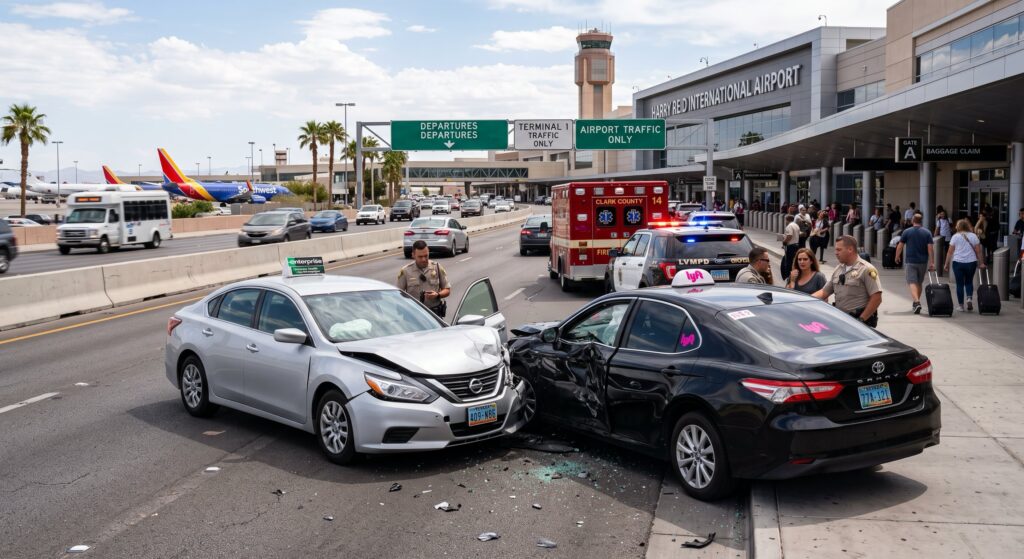
In late August and early September, tens of thousands of late-summer vacationers and convention attendees land at Harry Reid International Airport, shuttle to the Rent-A-Car Center on Gilespie Street, and immediately merge into some of the most congested freeway traffic in Nevada. Airport rental car crashes spike every August as unfamiliar drivers navigate the I-215 interchange, Paradise Road, and Sunset Road with rental vehicles they picked up minutes ago. If you were injured by a negligent rental car driver, a Las Vegas rental car accident attorney from Lerner and Rowe can cut through the complex insurance layers that define these cases and fight for the full compensation you deserve.
Rental car crash claims are more legally complex than standard car accident claims. The at-fault driver’s personal auto policy, the rental company’s liability coverage, credit card travel protection, and the collision damage waiver may all be relevant. Unsurprisingly, the companies behind each of those policies will work to minimize their share of the damages. Lerner and Rowe’s accomplished attorneys handle that complexity and know how to maximize your settlement.
The Risk of Airport Rental Car Crashes
The I-215 corridor between Harry Reid Airport and the Strip is one of the most dangerous stretches of freeway in Clark County for unfamiliar drivers. The interchange at Las Vegas Boulevard requires a quick lane change decision after a short merge lane — a configuration that regular commuters navigate by habit but that out-of-state drivers frequently fumble, producing abrupt braking and sideswipe crashes that affect every vehicle around them. August’s triple-digit heat adds tire blowout risk to every vehicle on the road, but rental cars that have been sitting in uncovered lots all day carry additional vulnerability.
Airport rental car crashes also cluster around the hotel access roads near Allegiant Stadium and the Mandalay Bay Resort, where tourists are simultaneously trying to navigate GPS instructions, find parking, and manage passengers who are reacting to their first look at the Strip. That combination of distraction and unfamiliarity at the exact moment a driver enters heavy pedestrian traffic is the setup for the crashes our attorneys handle regularly in August.
Tourist Rental Car Crash on I-215 in Las Vegas, Nevada
A tourist rental car crash on I-215 in Las Vegas, Nevada within the first mile of leaving the Rent-A-Car Center is more common than most people realize. Drivers who have just received their vehicle, are adjusting unfamiliar controls, and are simultaneously programming a GPS while entering freeway traffic at 65 mph are operating in a state of near-total distraction.
The I-215 eastbound approach to the Las Vegas Boulevard interchange requires a fast, accurate lane choice that distracted drivers frequently miss — producing emergency braking events that cause chain-reaction rear-end crashes in the vehicles behind them.
NDOT’s camera network on I-215 documents vehicle behavior at these interchange points. Lerner and Rowe requests that footage as part of every airport rental car crash investigation, along with the rental company’s vehicle checkout records that document exactly when and in what condition the vehicle left the facility.
Liability in Airport Rental Car Crashes
Liability in an airport rental car crash may rest with the at-fault driver personally, with the rental company if a vehicle defect contributed to the crash, or with both simultaneously. The federal Graves Amendment limits rental company liability in many crash scenarios, but it does not eliminate liability when the company’s own negligence — a mechanical defect, a failure to maintain the vehicle, or renting a vehicle to a driver with a known disqualifying condition — contributed to the crash. Lerner and Rowe investigates the full liability picture from day one.
Nevada’s modified comparative fault system means you can recover damages from an airport rental car crash as long as you are not found more than 50 percent responsible. An injured pedestrian or a driver who was hit by a rental car driver executing an unsafe maneuver has a strong claim regardless of what the rental company’s initial response suggests. Lerner and Rowe’s skilled attorneys build the evidence record that establishes the at-fault driver’s negligence and holds every liable party accountable.
Unfamiliar Driver Rental Car Collision in Clark County, Nevada
An unfamiliar driver rental car collision in Clark County, Nevada creates a specific legal scenario because driver unfamiliarity with local road conditions — while not a legal defense — is highly documentable as a contributing factor in establishing the driver’s negligence.
A driver who makes an abrupt, unsignaled lane change on a road they do not know, who misses a stop sign on Paradise Road because they are following GPS rather than watching the road, or who enters an intersection without yielding because they do not understand local signal timing has made a series of negligent decisions that the crash evidence can establish directly.
Rental car companies are required to provide drivers with basic safety information about the vehicle. When they rent to a driver who is visibly impaired, does not have a valid license, or has provided false information on the rental agreement, the company’s independent negligence may support a direct claim against the rental company alongside the driver liability claim. Lerner and Rowe examines the rental agreement and the checkout process records in every case where company negligence may be in play.
Insurance and Airport Rental Car Crashes
The insurance picture in an airport rental car crash is more complex than any other type of vehicle collision. Multiple potential sources of coverage may apply: the at-fault driver’s personal auto policy, the rental company’s supplemental liability coverage, the driver’s credit card travel protection program, the rental company’s collision damage waiver, and — if the driver was on a business trip — their employer’s commercial auto policy. Each of these policies has different limits, different exclusions, and different claims processes.
The shady tactics insurance companies may use to minimize rental car crash claims include arguing that the rental company’s coverage is primary and exhausted, that the driver’s personal policy excludes rental vehicles, and that the victim’s own policy’s uninsured/underinsured coverage should apply before any rental company liability is triggered. Lerner and Rowe’s attorneys know the exact legal priority of coverage in Nevada rental car claims and know how to challenge every attempt to shift the payment burden away from the responsible party.
Seeking Compensation for a Rental Car Accident in Nevada
Seeking compensation for a rental car accident in Nevada requires building a demand that accounts for every applicable insurance source and every recoverable element of the injury. Recoverable damages include emergency medical treatment, surgery and hospitalization, physical therapy for broken bones and soft tissue injuries, ongoing neurological care for brain injuries, lost wages, loss of future earning capacity, vehicle repair or replacement, and pain and suffering. In cases involving catastrophic injuries or wrongful death, the settlement must account for future costs that extend years beyond the crash.
Nevada Airport Rental Car Crashes FAQ
Lerner and Rowe has extensive experience handling airport rental car crash claims in Las Vegas, NV. Here are the questions our clients ask most often.
Nevada requires all drivers to carry minimum liability coverage, but out-of-state tourists in rental cars frequently carry only the rental company’s basic supplemental coverage rather than personal auto insurance. If the rental company’s supplemental liability policy applies, it covers third-party claims up to its limit. If that limit is inadequate, your own underinsured motorist coverage may apply. Lerner and Rowe identifies every available coverage source before any demand is made.
If you are the rental car driver and you caused a crash, the collision damage waiver covers the rental vehicle itself — it does not cover injuries to the other party. If you are the injured party in a crash caused by a rental car driver, the relevant question is what liability coverage applies. Lerner and Rowe navigates that determination for you so that you are pursuing the right policy at the right limits from the start.
A tourist who causes a crash and returns to their home state does not escape liability. Lerner and Rowe files claims against their personal auto policy and, where applicable, the rental company’s supplemental liability coverage. Nevada’s courts have jurisdiction over crashes that occur within the state, and we pursue those claims regardless of where the at-fault driver is located.
The federal Graves Amendment limits direct suits against rental companies based solely on vehicle ownership. However, when the company’s independent negligence contributed to the crash — a mechanical defect, a failure to perform required maintenance, or renting to a driver with a disqualifying record — a direct claim against the company is viable. Lerner and Rowe investigates the rental company’s role in every airport rental car crash case.
Nevada’s statute of limitations for personal injury claims is two years from the date of the crash under NRS 11.190. For tourist visitors who return home after a Las Vegas crash, that deadline applies regardless of residency. Contact Lerner and Rowe as soon as possible after any airport rental car crash — the sooner we are retained, the sooner evidence preservation begins.
Handling Airport Rental Car Crashes
The most important thing you can do immediately after an airport rental car crash is document the scene and seek medical attention. Get the at-fault driver’s rental agreement information alongside their driver’s license and insurance — the rental company name, contract number, and vehicle information are all critical to identifying the applicable coverage. Photograph the vehicle damage, your injuries, the road conditions, and any available traffic signage before the scene is cleared.
Lerner and Rowe has recovered billions for injury victims across the country, including victims of rental car crashes in Las Vegas who were dealing with out-of-state drivers and complex multi-policy insurance situations. We handle all communications with every insurer from the moment you retain us. Best of all, you pay nothing unless we win thanks to our “No Fee Promise.”
Do I Really Need a Las Vegas Rental Car Accident Lawyer?
A Las Vegas rental car accident lawyer from Lerner and Rowe is not optional when you are dealing with multiple insurance carriers, an at-fault driver who has returned to another state, and a rental company whose legal team has handled hundreds of similar claims. Navigating a complex legal matter alone can be overwhelming, especially while recovering from serious injuries. Our attorneys have the experience and skills to take care of all your legal needs so that you can focus on your health.
Call a Las Vegas Rental Car Crash Attorney Near Me
The Las Vegas personal injury attorneys at Lerner and Rowe are available 24 hours a day, 7 days a week. Our team handles airport rental car crashes, multi-policy insurance disputes, and out-of-state driver injury claims every day. You can trust our distinguished Las Vegas rental car accident attorney team to fight for the highest compensation allowed under Nevada law while you focus on your recovery.
Call Lerner and Rowe today to schedule your free, no-obligation consultation. We’re available by phone at (702) 877-1500. You can also reach us online through our LiveChat agents or by submitting your case details through our secure contact form.
The information on this blog is for general information purposes only. Nothing herein should be taken as legal advice for any individual case or situation. This information is not intended to create, and receipt or viewing does not constitute, an attorney-client relationship.