



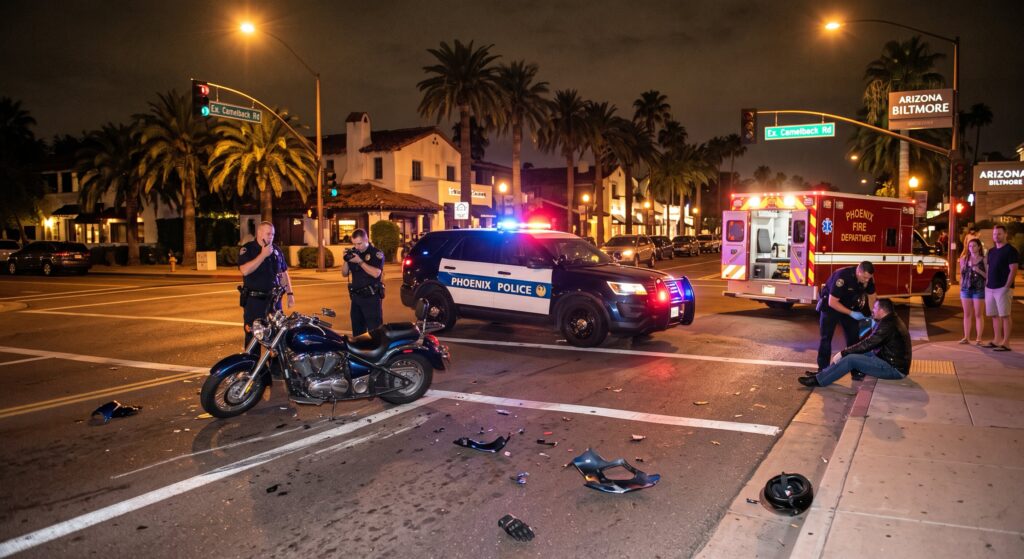
When Phoenix daytime temperatures top 110 degrees in August, riders shift their schedules — evening and late-night runs through the city become the only practical option for anyone who wants to be on the road at all. That shift brings August night riding motorcycle crashes into a concentrated pattern: dimly lit intersections, impaired drivers leaving entertainment districts, and sudden glare from oncoming headlights that temporarily blinds both riders and other motorists. A Phoenix motorcycle accident lawyer from Lerner and Rowe can investigate your crash and fight for every dollar you deserve.
Nighttime motorcycle crash claims in Phoenix involve anti-biker bias that is more aggressive than any other crash type. Insurers argue that darkness amplified whatever the rider did wrong. Lerner and Rowe’s experienced injury attorneys have countered that argument in Maricopa County claims hundreds of times and know exactly how to build the evidence record that dismantles it.
Risks of August Night Riding Motorcycle Crashes
August night riding motorcycle crashes in Phoenix cluster around a specific set of environmental and behavioral factors that make evening and late-night riding on the city’s major corridors genuinely more dangerous than daytime riding. Drivers who are tired after a full August workday, impaired after dinner and drinks at Roosevelt Row, or simply less alert at 10:00 p.m. than at 10:00 a.m. are sharing the road with riders who are harder to see and who have no structural protection from a collision.
The city’s major evening entertainment corridors — Central Avenue north of downtown, Camelback Road through the Biltmore district, and the I-10 approach to the Mortgage Matchup Center arena — all generate post-event vehicle surges that create concentrated distracted driver hazards for riders. A driver who is leaving a late-summer event, navigating unfamiliar roads, and checking their phone for directions creates exactly the conditions where a motorcycle in an adjacent lane becomes invisible.
Summer Night Motorcycle Accident in Phoenix, Arizona
A summer night motorcycle accident in Phoenix, Arizona carries a specific evidentiary profile that differs from a daytime crash. Nighttime traffic camera footage from the city’s intersection camera network captures vehicle behavior, light conditions, and approximate speeds.
Dashcam footage from other vehicles is more valuable — the vehicle’s headlights illuminate crash scenarios that would otherwise be poorly documented. Lerner and Rowe requests all available footage on the day we are retained, before retention windows close.
Rider visibility at night is a primary insurer argument. Lerner and Rowe’s Phoenix motorcycle accident lawyers counter it with the specific standards Arizona law imposes on all drivers — headlight use, following distance, and the obligation to maintain a lookout for other road users — that apply equally in darkness. A driver who could not see a properly lit motorcycle in an adjacent lane was not maintaining adequate attention, regardless of what the rider was wearing.
Downtown Corridors and Evening Riding Hazards
The downtown Phoenix entertainment district generates the most concentrated evening motorcycle crash risk in Maricopa County. Roosevelt Row Arts District and the blocks surrounding Talking Stick Resort Amphitheatre produce post-event vehicle surges that compress onto Central Avenue, 7th Street, and the I-10 ramps at exactly the hours when rider visibility is lowest. Drivers who are making rapid lane changes to reach the freeway on-ramp before the traffic backs up are the ones who strike riders they never saw.
The Mortgage Matchup Center arena district on 7th Street also generates late-evening vehicle surges after concerts and sporting events. The intersection of 7th Street and McDowell Road is a documented motorcycle crash concentration point during post-event egress, where left-turn failures and aggressive merging by drivers who are trying to beat the traffic produce the exact crash scenarios that August night riding motorcycle crashes follow.
Evening Riding Crash in Maricopa County, Arizona
An evening riding crash in Maricopa County, Arizona on the Phoenix metropolitan freeway system involves a specific hazard that surface street crashes do not: the speed differential between a motorcycle traveling at 65 mph and a vehicle that brakes suddenly without warning.
August freeway traffic on I-10, the Loop 101, and the Loop 202 during post-event and late-shift hours includes fatigued drivers who are slower to respond to changing conditions and more likely to make sudden, unannounced lane changes.
ADOT’s camera network covers all major Phoenix freeways and captures vehicle behavior at documented crash locations. Lerner and Rowe requests ADOT camera preservation immediately after being retained in every freeway motorcycle crash case — the footage that documents a vehicle’s lane change in the seconds before impact is the most valuable single piece of evidence in these claims.
August Night Riding Motorcycle Crashes and Liability
Arizona’s pure comparative fault system means a rider can recover damages from an August night riding motorcycle crash even if they contributed to the collision. The recovery is reduced proportionally by the rider’s fault percentage, but there is no cutoff that eliminates recovery entirely. The at-fault driver’s insurer will try to maximize the rider’s attributed fault — citing darkness, speed, lane position, and visibility gear — to reduce what they owe. Lerner and Rowe builds the evidence record that minimizes that percentage with the crash data, camera footage, and expert reconstruction testimony.
When a commercial vehicle, rideshare car, or company fleet vehicle is involved in an August night riding motorcycle crash, the employer’s or platform’s commercial liability policy enters the picture alongside the driver’s personal coverage. Commercial policies carry substantially higher limits than personal auto policies — and Lerner and Rowe’s skilled lawyers pursue those limits aggressively.
Distracted Driver Motorcycle Collision in Phoenix, Arizona
A distracted driver motorcycle collision in Phoenix, Arizona at night is documentable in ways that daytime crashes are not always. A driver who was on their phone when they drifted into a rider’s lane at 10:00 p.m. left phone records that show exactly what they were doing and at what timestamp. In-vehicle data systems on newer vehicles capture braking and steering input in the seconds before a crash. Lerner and Rowe pursues both categories of evidence immediately — the data that proves a driver was texting when they struck a rider is exactly what the insurer wants to suppress.
Arizona’s distracted driving law prohibits handheld phone use while driving. A driver who violated that law and caused a crash has committed negligence per se — the legal violation itself establishes fault without requiring proof of general carelessness. Lerner and Rowe documents that violation as the foundation of the liability case.
Insurers Blaming You for an August Night Crash
The shady tactics insurance companies use to minimize August night riding motorcycle crash claims follow a consistent script: the rider was speeding, lane splitting, not wearing reflective gear, or simply riding after dark in conditions where they should have known they were less visible.
Every version of that argument deflects from the driver’s specific negligent act and places the burden on the rider to prove they did nothing wrong. Lerner and Rowe reverses that dynamic — we document the driver’s negligence and force the insurer to defend it.
Early settlement offers in nighttime motorcycle crash claims are almost always inadequate. The insurer makes the offer before the rider’s full injury picture has developed and before the evidence has been fully gathered. Lerner and Rowe advises every client not to accept any offer without first understanding the complete value of the claim.
Seeking Compensation for a Motorcycle Accident in Arizona
Seeking compensation for a motorcycle accident in Arizona requires building a demand that accounts for every element of the injury. Recoverable damages include emergency medical treatment, surgery for broken bones and road rash, rehabilitation for brain injuries, lost wages during recovery, loss of future earning capacity if the injury is permanent, motorcycle repair or replacement, and pain and suffering. In cases involving catastrophic injuries or wrongful death, life care planning accounts for decades of future costs.
August Night Riding Motorcycle Crashes FAQ
Lerner and Rowe handles August night riding motorcycle crash claims across Maricopa County every summer. Here are the questions our clients ask most often.
How Much Does a Phoenix Motorcycle Accident Lawyer Cost?
Nothing unless we win. Lerner and Rowe handles every motorcycle crash case on a contingency basis under our “No Fee Promise.” You pay no legal fees unless and until we recover compensation for you. The initial consultation is always free.
What if I Wasn’t Wearing Reflective Gear or a Helmet?
Arizona does not require adult riders to wear helmets, and the absence of a helmet or reflective gear does not eliminate the at-fault driver’s liability. It may affect the comparative fault analysis — particularly for head injuries — but it does not bar recovery. Lerner and Rowe works with medical experts to distinguish what injuries were caused by the crash from what injuries, if any, were affected by gear choices.
Is Lane Splitting or Lane Filtering Legal in Arizona?
Arizona law now permits lane filtering under specific conditions — riders may filter between stopped vehicles at speeds under 15 mph when the road speed limit is 45 mph or higher. Full lane splitting at speed remains prohibited. If your crash involved lane filtering or splitting, Lerner and Rowe evaluates exactly what the law permitted and what it did not, and builds the liability case accordingly.
What Should I Do after a Nighttime Motorcycle Crash?
Call 911 immediately. A police report documents road conditions, lighting, and witness information before the scene is cleared. Get a same-day medical evaluation even if you feel functional — brain injuries, internal bleeding, and spinal injuries from motorcycle crashes frequently have delayed symptom onset. Do not give recorded statements to any insurer before speaking with Lerner and Rowe.
Will a Lawyer Review My August Night Riding Crash Case?
Yes. Lerner and Rowe reviews every August night riding motorcycle crash claim at no cost and with no obligation. Our Phoenix motorcycle accident lawyer team evaluates the crash, identifies every liable party and applicable insurance policy, and gives you an honest assessment of the claim’s value. If we take the case, you pay nothing unless we win.
Legal Help for August Night Riding Motorcycle Crashes
The Phoenix personal injury attorneys at Lerner and Rowe are available 24 hours a day, 7 days a week. Our team handles August night riding motorcycle crashes, anti-biker insurance disputes, and complex multiparty injury cases every day. With a proven track record of billion-dollar results, you can trust our distinguished Phoenix motorcycle accident lawyer team to fight for the highest compensation allowed under Arizona law while you focus on your recovery.
Call us today to schedule your free, no-obligation consultation. You can also reach us online through our LiveChat representatives or by submitting your case details through our encrypted contact form.
The information on this blog is for general information purposes only. Nothing herein should be taken as legal advice for any individual case or situation. This information is not intended to create, and receipt or viewing does not constitute, an attorney-client relationship.