



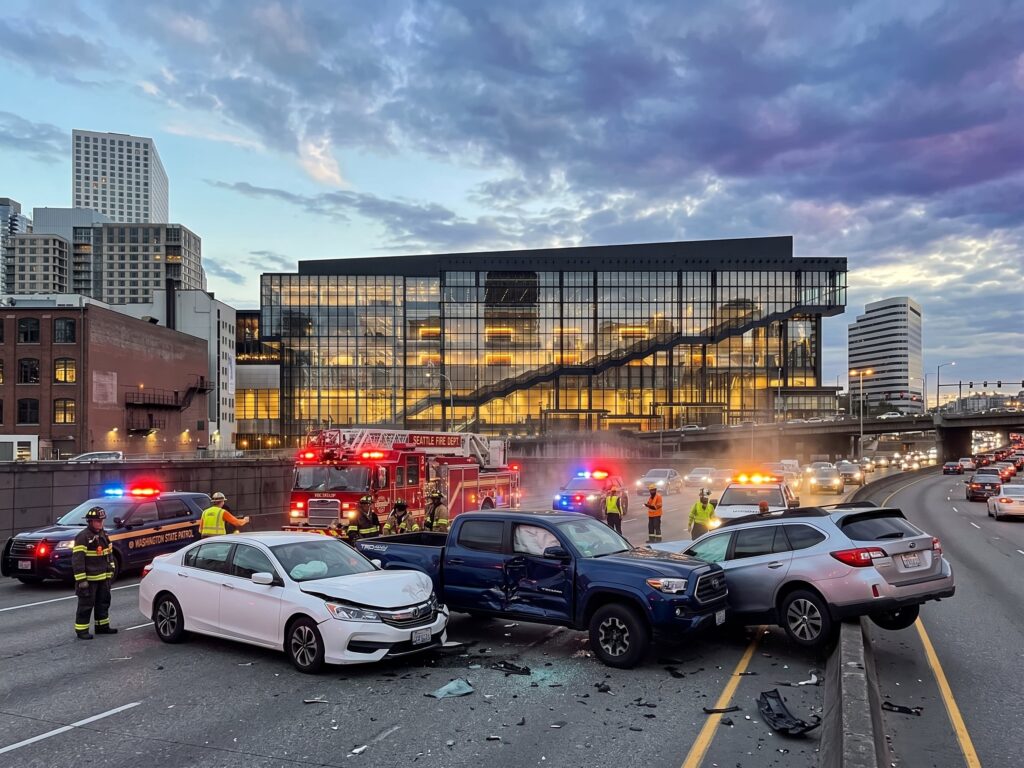
Late summer is prime construction season on the Puget Sound’s highway network, and I-5 through Seattle carries the highest volume and the tightest work zone restrictions of any corridor in the region. When lanes close near the Seattle Convention Center interchange or approaching the Ship Canal Bridge, thousands of vehicles compress into fewer lanes with little warning. An I-5 work zone crash in Seattle in that environment, can involve multiple vehicles and produce serious injuries in seconds. If a distracted or aggressive driver caused your crash, a Seattle car accident lawyer from Lerner and Rowe can investigate what happened and fight for the compensation you deserve.
Work zone crash claims are more complex than standard automobile accident claims. The driver, a contractor whose inadequate signage created the hazard, and WSDOT itself may all share liability depending on what caused the collision. Lerner and Rowe’s accomplished Washington injury attorneys identify every liable party from day one, so nothing falls through the cracks and no responsible party escapes accountability.
Causes of an I-5 Work Zone Crash
A summer construction car crash on I-5 in August typically results from one or more driver failures that are predictable, preventable, and legally actionable. The specific causes our Seattle car accident lawyer team sees most often in I-5 work zone claims include the following.
- Following too closely: Stop-and-go work zone traffic requires significantly extended following distances. Drivers who close the gap have no stopping room when traffic halts without warning.
- Failure to merge safely: Drivers who wait until the last moment to merge — or who refuse to yield to merging vehicles — create the sudden lateral conflicts that produce sideswipe crashes in lane-closure transition zones.
- Distracted driving: Drivers checking phones, adjusting navigation, or managing passengers miss the sudden speed reductions that work zone configurations demand. A distracted driver traveling at 50 mph who looks down for 3 seconds covers over 200 feet without watching the road.
- Inadequate signage: Federal and Washington state standards require specific advance warning distances for work zone lane closures. When a contractor fails to meet those standards, every crash that results carries a potential government or contractor liability angle.
- Speed violations: Washington doubles fines for speeding in work zones and imposes enhanced penalties for crashes that injure workers. A driver who was speeding when they struck your vehicle faces both civil and potential criminal exposure.
Navigating Summer Highway Bottlenecks
The I-5 corridor through Seattle has several documented crash concentration zones during summer construction season. The stretch between the University of Washington interchange and the Ship Canal Bridge carries enormous volumes of commuter and tourist traffic that compresses dramatically when construction narrows lanes approaching the bridge.
The downtown express lane system between Seneca Street and Mercer Street creates merge conflicts during lane configuration changes that catch out-of-town drivers completely off guard.
Highway work zone accidents near Seattle, Washington also cluster near the I-5/I-90 interchange, where summer construction activity on the floating bridge approach intersects with heavy tourist traffic heading to Mount Rainier National Park and eastern Washington destinations. Drivers unfamiliar with the interchange geometry make last-second lane changes that force following vehicles into emergency braking situations.
Rear-End Collision in King County, Washington
A rear-end collision in King County, Washington in an active work zone is the most common automobile crash type in summer construction corridor claims, and it is also the most frequently underestimated. Insurance adjusters for the at-fault driver will argue that low-speed work zone rear-end impacts cannot cause serious injuries. That argument is medically wrong, and Lerner and Rowe’s attorneys dismantle it with medical expert documentation every time.
The sudden deceleration forces in a rear-end work zone crash — even at 25 mph — produce cervical spine loading that exceeds the threshold for soft tissue injury in many adults. When the vehicle ahead stops suddenly due to construction traffic and the following driver has no stopping distance, the resulting crash can cause whiplash, disc herniation, and neurological symptoms that outlast any visible vehicle damage by months.
Injuries from an I-5 Work Zone Crash
An I-5 work zone crash in Seattle produces injuries across the full range of severity, from soft tissue damage and whiplash that require months of physical therapy to catastrophic outcomes that reshape a victim’s life permanently. Even crashes that appear minor based on vehicle damage can produce serious cervical and lumbar spine injuries that are not visible on standard X-rays and require MRI evaluation to document.
In moderate to high-speed work zone crashes, broken bones — particularly to the sternum, ribs, and wrists — are common outcomes of both front and rear impacts. Traumatic brain injuries from head strikes against airbag systems, door pillars, or windows produce cognitive and neurological symptoms that may not peak until 24 to 72 hours after the crash. In the most severe multi-vehicle work zone crashes, catastrophic injuries and wrongful death are outcomes that Lerner and Rowe has helped families navigate.
The Hidden Trauma of Sudden Traffic Shifts
Work zone crashes carry a specific injury pattern that standard car accident claims often miss: the psychological trauma of a sudden, unexpected collision in a high-stress environment. Drivers and passengers who experience a serious work zone crash frequently develop anxiety responses to highway driving, particularly in construction zones, that affect their work life and quality of life independently of any physical injury. These psychological effects are compensable damages in Washington, and Lerner and Rowe’s attorneys document them as part of the full claim.
The physical injury picture in work zone crashes is also frequently complicated by the involvement of multiple vehicles. A chain-reaction rear-end crash involving three or four vehicles creates overlapping injury mechanisms — the initial impact, the secondary impact from the vehicle behind, and the restraint-system injuries from seat belt loading — that require careful medical documentation to untangle. A Seattle car accident lawyer from Lerner and Rowe coordinates that documentation from the start.
Fault in an I-5 Work Zone Crash
Washington uses a pure comparative fault system, meaning you can recover damages from an I-5 work zone crash in Seattle even if you were partly responsible for the collision. Your award is reduced proportionally, but you are never completely barred from recovery. In a work zone crash, fault may rest with the at-fault driver, a construction contractor whose inadequate signage or lane configuration contributed to the crash, or WSDOT if the approved traffic control plan was unreasonably dangerous.
Claims against government entities in Washington require specific procedural steps, including a tort claim notice filed within the statute of limitations window. Missing those steps can bar recovery against WSDOT or a county agency even when they share liability. Lerner and Rowe’s experienced injury attorneys handle those procedural requirements from the moment we take the case, so no deadline is ever missed.
Seattle Work Zone Accidents and Liability
Seattle work zone accidents involve a liability picture that car accident claims on standard roads do not. A contractor who submitted a traffic control plan that WSDOT approved, but then failed to implement that plan correctly in the field, is independently liable for crashes that result from the discrepancy. Maintenance contractors who allow lane markings to degrade, warning signs to fall, or work zone boundaries to shift without updated advance signage create hazards for which they can be held accountable separately from the at-fault driver.
Lerner and Rowe requests the applicable traffic control plan, the contractor’s daily field logs, and WSDOT’s inspection records for the work zone where your crash occurred. That documentation frequently reveals violations of the approved plan that support a contractor liability claim alongside the driver negligence case.
Damages for an I-5 Work Zone Crash
Recoverable damages in an I-5 work zone crash claim include emergency medical treatment, surgery and hospitalization, physical therapy and rehabilitation, lost wages during recovery, loss of future earning capacity if the injury produces permanent limitations, vehicle repair or replacement, and pain and suffering. In cases involving catastrophic injury or wrongful death, life care planning accounts for decades of future costs that the settlement must reflect in full.
Lerner and Rowe has recovered over $1 billion for injury victims nationwide in the last three years. Our attorneys work with medical specialists and financial experts to build demands that reflect what an I-5 work zone crash in Seattle actually costs, not the minimum a driver’s insurer or a contractor’s liability carrier is willing to offer.
Seeking Compensation for Auto Accident Injuries in Washington
Seeking compensation for auto accident injuries in Washington requires understanding how Washington’s pure comparative fault system interacts with the specific liability structure of a work zone crash. When multiple parties share fault — the driver, the contractor, WSDOT — the recovery comes from multiple insurance policies simultaneously. Coordinating those claims without an attorney means dealing with multiple adjusters who are each trying to minimize their client’s share of the damages. Lerner and Rowe handles all of those conversations on your behalf.
Washington’s statute of limitations for personal injury claims is three years from the date of the crash under RCW 4.16.080. Claims against government entities may have shorter notice deadlines. Contact Lerner and Rowe immediately after any I-5 work zone crash in Seattle, and remember that you pay nothing unless we win thanks to our “No Fee Promise“.
Preserving I-5 Work Zone Crash Evidence
Work zone crash evidence disappears fast. The lane configuration that existed at the moment of your crash may be reconfigured overnight. WSDOT traffic camera footage operates on a 30-day retention cycle. Construction contractor daily logs are retained only for the duration of the project phase. Lerner and Rowe sends preservation letters to WSDOT, the relevant contractor, and any adjacent businesses with parking lot cameras within hours of being retained — before that window closes.
Dashcam footage from other vehicles on I-5 at the time of the crash is often the most valuable single piece of evidence in a work zone claim. Our attorneys identify and contact potential dashcam witnesses immediately, and we pursue any commercial vehicle dashcam footage — from trucks, buses, or rideshare vehicles — that may have captured the crash sequence.
Contact a Seattle Car Accident Lawyer Near Me
The Seattle personal injury attorneys at Lerner and Rowe are available 24 hours a day, 7 days a week. Our team handles I-5 work zone crash in Seattle claims, contractor liability disputes, and complex multi-party injury cases every day. You can trust our distinguished Seattle car accident lawyer team to fight for the highest compensation allowed under Washington law while you focus on your recovery.
Call Lerner and Rowe today to schedule your free, no-obligation consultation. Our team is available by phone at 206-333-4400. You can also reach us through our online LiveChat representatives or by submitting your case details through our secure contact form.
The information on this blog is for general information purposes only. Nothing herein should be taken as legal advice for any individual case or situation. This information is not intended to create, and receipt or viewing does not constitute, an attorney-client relationship.