



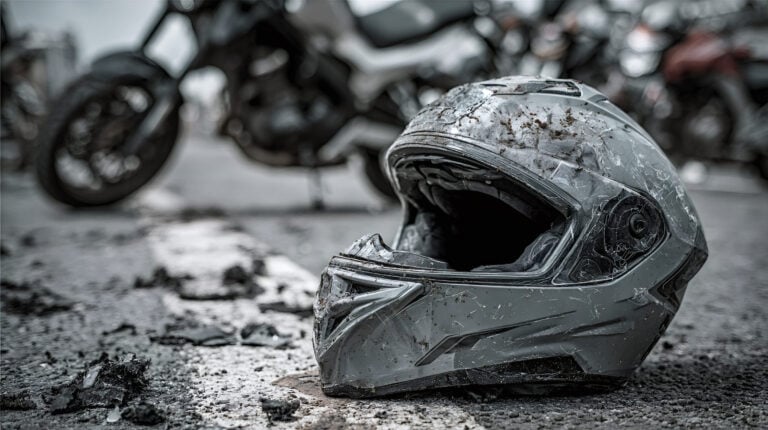
Motorcycle crashes can cause devastating injuries, even when a rider is wearing protective gear and following the rules of the road. In Valparaiso and throughout Porter County, motorcyclists share busy highways and local roads with cars, trucks, and commercial vehicles. When another driver fails to see a motorcycle, turns left in front of a rider, changes lanes without checking a blind spot, or follows too closely, the consequences can be severe. If you were injured in a motorcycle crash caused by another person’s negligence, a motorcycle accident lawyer in Valparaiso, Indiana may be able to help you understand your legal options. Read on for this helpful guide from the Valparaiso motorcycle accident lawyers at Lerner and Rowe.
Why Motorcycle Accident Claims Can Be Different in Indiana
Motorcyclists have the same rights to use Indiana roads as other motorists. Indiana’s Bureau of Motor Vehicles notes that motorcycles are entitled to a full traffic lane, and state safety guidance reminds drivers to check blind spots, watch carefully at intersections, and be especially cautious when making left turns. Yet motorcycle crashes often present unique challenges when insurance companies investigate liability.
A motorcycle’s smaller profile can make it easier for a driver to claim they did not see the rider. Insurance adjusters may also scrutinize the motorcyclist’s speed, lane position, protective equipment, licensing, and other factors when evaluating a claim.
That does not mean a motorcyclist is automatically responsible for an Indiana comparative fault motorcycle crash.
Indiana law requires insurance companies and other parties to evaluate the specific facts of a collision. If another driver caused the crash, the injured rider may have a right to seek compensation—even if the insurer attempts to shift some of the blame to the motorcyclist.
This is one reason working with a Valparaiso motorcycle injury attorney can be important after a serious collision. A thorough investigation may reveal evidence that challenges assumptions about what happened and establishes who was actually responsible.
Indiana Motorcycle Law IC 9-19-7 and Helmet Requirements
Indiana’s motorcycle laws include specific equipment and operating requirements. One issue that often becomes a focus of motorcycle injury claims is helmet use. Indiana requires motorcycle operators and passengers under age 18 to wear a helmet and eye protection. Motorcycle operators riding with a motorcycle learner’s permit are also required to wear a helmet.
For adult riders who are not operating under a learner’s permit, Indiana does not impose a universal helmet requirement in the same way that some states do. However, the absence of a helmet requirement does not give another driver permission to cause a crash.
If an adult rider was lawfully operating a motorcycle without a helmet and another driver caused a collision, the other driver’s conduct remains relevant to determining liability. At the same time, the insurance company may argue that helmet nonuse is relevant to the nature or extent of certain injuries.
That argument must be examined carefully. The question is not simply whether the rider was wearing a helmet. The more important questions may include:
- Who caused the collision?
- What injuries were directly caused by the crash?
- Which injuries, if any, could reasonably be attributed to helmet use or nonuse?
- What evidence supports the insurance company’s position?
- Does the evidence actually establish that the rider’s conduct contributed to the claimed damages?
A motorcycle accident claim should be evaluated based on the evidence rather than stereotypes about motorcyclists.
Motorcycle Accident Lawyer in Valparaiso, Indiana: Insurance Requirements
Indiana requires motorists to maintain financial responsibility. The state’s minimum liability insurance requirements are commonly described as 25/50/25: $25,000 for bodily injury or death of one person, $50,000 for bodily injury or death of two or more people in one accident, and $25,000 for property damage in one accident.
These minimum limits may be inadequate after a serious motorcycle crash.
Motorcyclists can suffer catastrophic injuries in collisions with passenger vehicles and commercial trucks. Medical bills, rehabilitation, lost income, future care, and other damages can quickly exceed the at-fault driver’s minimum insurance limits.
Insurance coverage may therefore become an important part of a motorcycle accident investigation. Depending on the circumstances, an injured rider may need to examine:
- The at-fault driver’s liability coverage
- The motorcycle rider’s own insurance policy
- Uninsured motorist coverage
- Underinsured motorist coverage
- Additional applicable insurance policies
- Potential liability involving another responsible party
Indiana’s Department of Insurance states that newly written auto liability policies generally include uninsured and underinsured motorist coverage unless the insured rejects that coverage in writing.
Because motorcycle insurance policies can contain specific terms and exclusions, an injured rider should carefully review available coverage before accepting an insurance settlement.
Porter County Motorcycle Crash Risks
Motorcyclists in and around Valparaiso regularly travel roads that connect communities throughout Porter County and Northwest Indiana. Routes such as US-30, US-6, and IN-49 can involve substantial traffic, intersections, lane changes, higher speeds, and interactions between motorcycles and larger vehicles.
The specific circumstances of a crash matter more than simply identifying the roadway. However, certain collision scenarios can be particularly dangerous for motorcyclists.
US-30 Motorcycle Crashes
US-30 carries significant traffic through Northwest Indiana. Intersections, turning vehicles, lane changes, and traffic congestion can create opportunities for drivers to overlook motorcycles.
A driver turning left across a motorcycle’s path may claim the rider appeared suddenly. A driver changing lanes may say the motorcycle was in a blind spot.
An investigation should examine whether the driver had a reasonable opportunity to see the motorcycle and whether the driver failed to maintain a proper lookout.
US-6 Motorcycle Crashes
US-6 connects communities across the region and includes areas where motorcycles may encounter changing traffic patterns, intersections, and varying road conditions.
If a crash occurs on US-6, evidence such as roadway design, visibility, signage, lighting, weather, and traffic conditions may help establish how the collision occurred.
IN-49 Motorcycle Crashes
IN-49 is another important route through the Valparaiso area and can involve a mix of local and through traffic.
Crashes involving motorcycles may occur when drivers turn, merge, enter roadways, or change lanes without adequately checking for smaller vehicles.
Indiana State Police specifically warns drivers to check blind spots before changing lanes and to use caution when turning left because left-turning vehicles are a primary source of collisions between motorcycles and passenger vehicles.
Motorcycle Accident Lawyer in Valparaiso, Indiana: Comparative Fault
One of the most important legal issues in an Indiana motorcycle accident claim is comparative fault.
Indiana follows a modified comparative-fault system. Under Indiana Code 34-51-2, an injured person who is found to be more than 50% responsible for their injuries generally cannot recover damages. If the injured person’s share of fault is 50% or less, their damages may be reduced proportionally based on their assigned percentage of fault.
For example, imagine that a jury determines a motorcyclist suffered $200,000 in damages but was 20% responsible for the crash. The motorcyclist’s potential recovery could be reduced by 20%, resulting in $160,000 before other legal considerations.
The stakes become much higher if an insurance company tries to assign a large percentage of fault to the rider.
This is where what some attorneys and advocates describe as “biker bias” can become an issue. Some drivers, witnesses, and insurance adjusters may enter a motorcycle crash investigation with assumptions that the rider was speeding, riding recklessly, or otherwise responsible simply because they were operating a motorcycle.
But assumptions are not evidence.
A strong motorcycle accident investigation should focus on objective facts, including vehicle damage, skid marks, crash-scene measurements, witness statements, video footage, traffic signals, vehicle data, and the testimony of qualified experts when appropriate.
If the other driver says, “I didn’t see you,” that statement may actually be an important part of the investigation. The question becomes why the driver failed to see the motorcycle and whether that failure contributed to the crash.
“I Didn’t See You”: A Common Motorcycle Crash Defense
“I didn’t see the motorcycle” is a phrase frequently associated with motorcycle collisions.
A driver may genuinely have failed to see the rider. But failing to see another vehicle does not necessarily eliminate liability.
Drivers have a duty to operate their vehicles with reasonable care. Depending on the circumstances, that can include:
- Checking mirrors and blind spots
- Looking for motorcycles before changing lanes
- Yielding when required
- Maintaining a proper lookout
- Following at a safe distance
- Obeying traffic signals
- Exercising caution when turning left
- Adjusting driving to weather and road conditions
Indiana’s motorcycle awareness guidance specifically emphasizes that motorcycles can be difficult to see because of their smaller profile and encourages drivers to check mirrors and blind spots before entering or leaving a lane.
A driver who says they did not see a motorcycle may still be found responsible if the evidence shows that they failed to look carefully enough or otherwise drove negligently.
Motorcycle Accident Lawyer in Valparaiso, Indiana: Is Lane Splitting Legal?
Lane splitting generally refers to a motorcyclist riding between lanes of traffic traveling in the same direction. Lane filtering is a related maneuver involving movement between stopped or slow-moving vehicles.
Indiana law gives motorcycles the full use of a traffic lane and prohibits operating a vehicle in a manner that deprives another vehicle of the full use of a traffic lane. Indiana law also permits two motorcycles to ride abreast in a single lane when both operators consent.
Indiana law does not authorize lane splitting, and Indiana’s traffic laws effectively prohibit riding between lanes of traffic.
This can become relevant when insurance companies investigate a motorcycle collision. If a rider was lane splitting when a crash occurred, the insurer may argue that the rider violated traffic laws and should bear some or all of the responsibility.
However, even if a motorcyclist violated a traffic rule, that does not automatically answer every question about liability. The investigation should still determine whether the violation actually contributed to the collision and how much responsibility should fairly be assigned to each party.
Indiana’s comparative fault rules make these distinctions particularly important.
Evidence That Can Strengthen a Motorcycle Accident Claim
Motorcycle crashes can happen quickly. Physical evidence may disappear, vehicles may be repaired, and memories can become less reliable over time.
For that reason, an early investigation can be critical.
Depending on the circumstances, evidence in a motorcycle accident case may include:
Electronic Data and EDR Evidence
Some vehicles contain event data recorders (EDRs) that may preserve information about vehicle operation around the time of a crash.
Depending on the vehicle and circumstances, available data may help investigators evaluate factors such as speed, braking, and other collision-related information.
Dashcam and Surveillance Video
Video can be among the most valuable forms of evidence in a motorcycle collision.
Potential sources may include:
- Dashboard cameras
- Traffic cameras
- Nearby businesses
- Residential security systems
- Doorbell cameras
- Cellphone recordings
- Vehicle camera systems
Because some surveillance systems automatically overwrite older footage, identifying and preserving relevant video as soon as possible may be important.
Weather and Road Condition Records
Weather can affect visibility, traction, and stopping distances. Road conditions can also play a role in a motorcycle crash.
Depending on the circumstances, investigators may examine:
- Rainfall
- Snow or ice
- Visibility
- Road surface conditions
- Construction zones
- Potholes
- Debris
- Roadway maintenance
- Lighting conditions
This information can help determine whether weather or road conditions contributed to the crash, or whether another driver’s actions were the primary cause.
Independent Accident Reconstruction
In serious or disputed motorcycle crashes, an independent accident reconstruction may be valuable.
An accident reconstruction professional may analyze physical evidence, photographs, vehicle damage, road measurements, video, EDR data, witness statements, and other information to develop an evidence-based explanation of how the crash occurred.
This can be particularly important when the parties disagree about speed, lane position, visibility, or who had the right of way.
Motorcycle Accident Lawyer in Valparaiso, Indiana FAQs
1. Do I need an Indiana motorcycle accident lawyer after a crash?
You are not legally required to hire a Porter County motorcycle crash attorney after a motorcycle accident. However, legal representation may be beneficial when injuries are serious, liability is disputed, insurance coverage is limited, or an insurer attempts to blame you for the crash. A lawyer can investigate the collision and help protect your interests during insurance negotiations or litigation.
2. Can I recover compensation if I was partly at fault for an Indiana motorcycle accident?
Possibly. Indiana generally follows a modified comparative fault system. If you are 50% or less at fault, your damages may be reduced according to your percentage of fault. If you are found to be more than 50% responsible, you generally cannot recover damages under Indiana’s Comparative Fault Act.
3. Is lane splitting legal in Indiana?
No. Indiana law provides that motorcycles are entitled to the full use of a traffic lane and prohibits operating a vehicle in a way that deprives another vehicle of the full use of a traffic lane. Two motorcycles may ride abreast in one lane with the consent of both riders, but lane splitting between rows of traffic is not permitted.
4. What if the driver who hit me says they did not see my motorcycle?
A driver’s claim that they did not see a motorcycle does not automatically eliminate liability. The investigation should examine whether the driver was keeping a proper lookout, checking blind spots, yielding when required, and otherwise operating the vehicle safely. Evidence such as video, witness testimony, vehicle data, and accident reconstruction may help determine what happened.
5. How much is a motorcycle accident settlement in Indiana worth?
There is no standard settlement amount for motorcycle crashes. The potential value of a claim depends on factors such as injury severity, medical expenses, lost income, future damages, insurance coverage, liability, comparative fault, and the available evidence. An experienced motorcycle accident attorney can review the facts of an individual case and help assess potential legal options.
Contact a Motorcycle Accident Lawyer in Valparaiso, Indiana
A motorcycle crash can change your life in a matter of seconds. Serious injuries can lead to extensive medical treatment, time away from work, and long-term physical and financial challenges.
If you were injured in a motorcycle accident in Valparaiso or elsewhere in Porter County, you do not have to face the insurance company alone. The Valparaiso personal injury lawyers at Lerner and Rowe can help investigate what happened and pursue the compensation you may be entitled to receive.
Contact Lerner and Rowe to discuss your case and learn more about your legal options. Give us a call, fill out a contact form, or use LiveChat today for a free consultation.
The information on this blog is for general information purposes only. Nothing herein should be taken as legal advice for any individual case or situation. This information is not intended to create, and receipt or viewing does not constitute, an attorney-client relationship.