



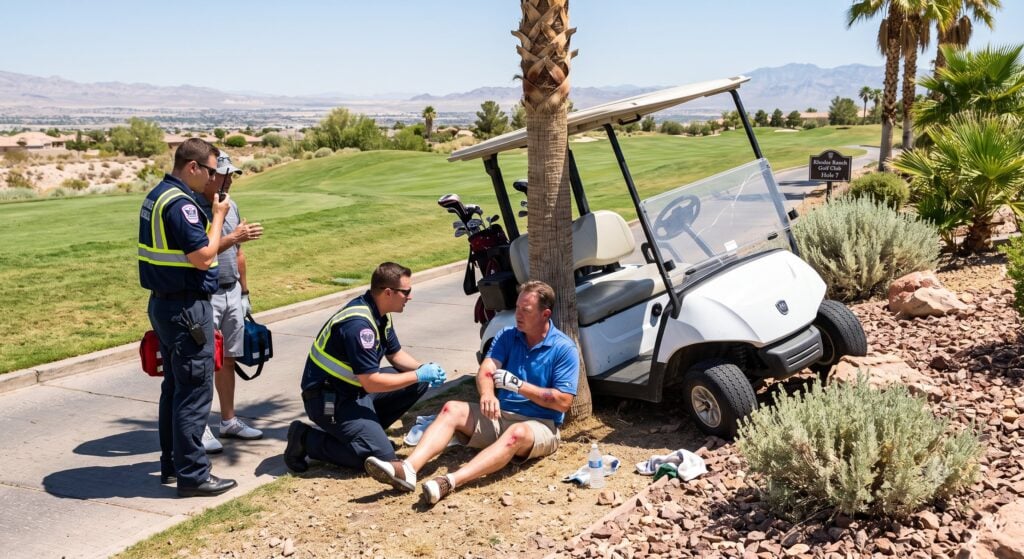
When July heat pushes Las Vegas temperatures past 110 degrees, residents in master-planned communities across the valley reach for their golf cart keys. It’s the practical choice — a short trip to the pool, the clubhouse, or a neighbor’s house without sitting in a baking car. Unfortunately, a golf cart crash in Las Vegas is far more dangerous than most people realize. These vehicles have no airbags, no structural doors, and often no seatbelts. A sharp turn, a missed curb, or a collision with a passenger car can eject riders completely. If you were injured, a Las Vegas golf cart accident lawyer from Lerner and Rowe can win you the full and fair compensation you deserve.
Golf cart injury claims involve a more complex liability picture than standard car accidents. The cart driver, the community HOA, a golf course or resort, a maintenance company, or even the cart manufacturer may all share responsibility depending on what caused the crash. Lerner and Rowe’s accomplished Nevada injury attorneys identify every liable party from day one.
Summer Golf Cart Hazards in Master Communities
Las Vegas master-planned communities permit golf carts on designated paths and, in some areas, on public streets. Sun City Summerlin, Rhodes Ranch, and Tuscany all see heavy golf cart activity during summer months when residents use them for daily errands within the community. That volume spikes further in July as residents maximize early morning rounds before the worst of the heat.
The same heat that drives golf cart use also creates hazards on the paths themselves. Asphalt cart paths expand and crack in extreme temperatures, creating surface irregularities that can catch a wheel unexpectedly. Community maintenance crews that fall behind on path repairs during summer staffing gaps leave hazards that persist for weeks. A golf cart crash in Las Vegas caused by a poorly maintained community path is a premises liability claim against the HOA or managing entity.
The Risk of a Sun City Summerlin Golf Cart Accident
A Sun City Summerlin golf cart accident is a specific scenario Lerner and Rowe’s attorneys handle. The community’s extensive cart path network runs alongside busy roads and crosses several public street intersections where golf cart operators and vehicle drivers frequently misjudge each other’s speed and right of way. Early morning rounds generate the most traffic on these paths, and the combination of sun glare, tired drivers, and crowded tee-time queues produces a predictable collision environment.
When a golf cart crash in Las Vegas happens at a community path crossing with a public road, the liability question spans multiple parties — the cart driver, potentially the HOA for inadequate signage or sight line maintenance, and the vehicle driver if they failed to yield. Our attorneys investigate every angle simultaneously.
Causes of a Golf Cart Crash in Las Vegas
The causes our Las Vegas golf cart accident lawyer team sees most often in Clark County golf cart crash claims include the following.
- Reckless or impaired driving: Golf carts are treated as vehicles under Nevada law, which means a driver who operates one while impaired faces the same legal exposure as a drunk driver in a passenger car.
- Excessive speed on cart paths: Modern utility carts can reach 25 mph. On narrow community paths shared with pedestrians and cyclists, that speed leaves almost no margin for error.
- Sharp turns on uneven terrain: Golf carts have a high center of gravity relative to their wheelbase. Aggressive turns — especially on sloped cart paths or rough terrain — produce rollovers that eject passengers who have nothing to hold them in.
- Poor path maintenance: Cracked asphalt, eroded edges, unrepaired potholes, and inadequate drainage on community cart paths are maintenance failures that the responsible HOA or golf course is obligated to correct.
- Collisions with passenger vehicles: Where cart paths cross public roads, distracted drivers who fail to yield to cart operators cause collisions that can send riders flying from a vehicle with no protective cage.
Overturned Golf Cart Injury in Clark County, NV
An overturned golf cart injury in Clark County, NV is among the most serious outcomes of a cart crash because there is nothing to protect the occupants from the ground or from the cart itself landing on top of them.
Head injuries from pavement impact, broken bones — particularly to the wrists, arms, and collarbones from bracing for impact — and spinal injuries from the force of ejection are all documented outcomes of cart rollovers, even at the low speeds most community carts operate at.
The head injury risk in a golf cart rollover is particularly high because most riders are not wearing helmets. A traumatic brain injury sustained when a rider’s head strikes the cart path or the overturned vehicle can produce cognitive effects that do not fully manifest for days after the crash. Same-day medical evaluation and neurological follow-up are both critical to your health and your legal claim.
Liability in a Golf Cart Crash in Las Vegas
Nevada’s modified comparative fault system means you can recover compensation for a golf cart crash in Las Vegas even if you contributed to the crash in some way. Your damages are reduced proportionally, but you are never completely barred from recovery. The defendants — the cart driver, the HOA, the golf course, or the manufacturer — will each try to shift fault onto you. Lerner and Rowe’s skilled attorneys build the evidence record that counters every version of that argument.
When a negligent cart driver in Las Vegas, NV causes a crash on a public road, Nevada vehicle law applies in full — including the requirement to carry liability insurance. When the crash happens on private community property, the HOA or resort’s general liability policy governs. These are different insurance structures with different claims processes, and knowing which applies to your crash matters from the first day of the investigation.
Why You Need a Las Vegas Golf Cart Accident Lawyer
Golf cart crash claims involve defendants who will minimize your injuries, dispute the crash conditions, and argue that a low-speed vehicle cannot cause serious harm. Lerner and Rowe’s Las Vegas golf cart accident lawyer team knows every version of that defense and knows how to dismantle it with medical expert documentation, path maintenance records, and the physical evidence from the crash site.
We handle all communication with the relevant insurers from the moment you retain us, request preservation of any available surveillance footage from community cameras, and pursue HOA maintenance records that document how long a hazardous path condition had been known before your crash. You pay nothing unless we win, thanks to our “no fee promise.”
Golf Cart Crash in Las Vegas FAQ
Lerner and Rowe handles golf cart injury claims across Las Vegas, Henderson, Summerlin, and the surrounding master communities every day. Here are the questions our clients ask most often.
Who is liable if I was struck by a golf cart in Nevada?
If you were struck by a golf cart in Nevada on a public road, the cart operator’s personal liability insurance applies. On private community or resort property, the operator’s personal liability coverage and the property owner’s general liability policy may both be relevant. When the crash was caused by a path defect, the HOA or property manager carries the primary liability exposure.
Does auto insurance cover a golf cart crash in Las Vegas?
It depends on where the crash occurred and what type of cart was involved. Standard personal auto policies typically exclude golf carts. Some homeowner’s policies include limited golf cart coverage for private property use. Low-speed vehicles permitted on public roads may require a separate endorsement. Lerner and Rowe identifies every applicable policy for your specific crash before any demand is made.
Can I sue a driver if I fall out of a moving cart?
Yes, if the driver’s actions caused your ejection. A sharp turn made without warning, excessive speed for the path conditions, or driving over a hazard the driver should have seen are all grounds for a negligence claim. Nevada’s comparative fault rules mean the driver’s percentage of responsibility determines your recovery, but a fall that results from reckless operation can produce a strong claim even if you were not wearing a seatbelt.
What if my golf cart crash in Las Vegas was on a bad road?
If a poorly maintained path or road surface caused your crash, the entity responsible for maintaining that surface — the HOA, the golf course, the City of Las Vegas, or Clark County — may be liable. Government entity claims involve strict notice and procedural requirements with deadlines as short as 90 days. Contact Lerner and Rowe immediately after any crash involving a road or path defect.
What compensation can I recover for my injuries?
Recoverable damages include emergency medical treatment, surgery and hospitalization, physical therapy and rehabilitation, lost wages, loss of future earning capacity if the injury is permanent, and pain and suffering. In cases involving catastrophic injuries or permanent disability, life care planning accounts for future costs that a settlement must reflect in full.
Hurt in a Golf Cart Crash in Las Vegas?
The Las Vegas personal injury attorneys at Lerner and Rowe are available 24 hours a day, 7 days a week. Our team handles golf cart crash in Las Vegas claims, HOA liability disputes, and complex multi-party injury cases every day. You can trust our experienced Las Vegas golf cart accident lawyer team to fight for the highest compensation allowed under Nevada law while you focus on recuperation.
Call Lerner and Rowe today to schedule your free, no-obligation consultation. We’re available by phone at (702) 877-1500. You can also reach us online through our LiveChat representatives or by submitting your case details through our secure contact form.
The information on this blog is for general information purposes only. Nothing herein should be taken as legal advice for any individual case or situation. This information is not intended to create, and receipt or viewing does not constitute, an attorney-client relationship.