



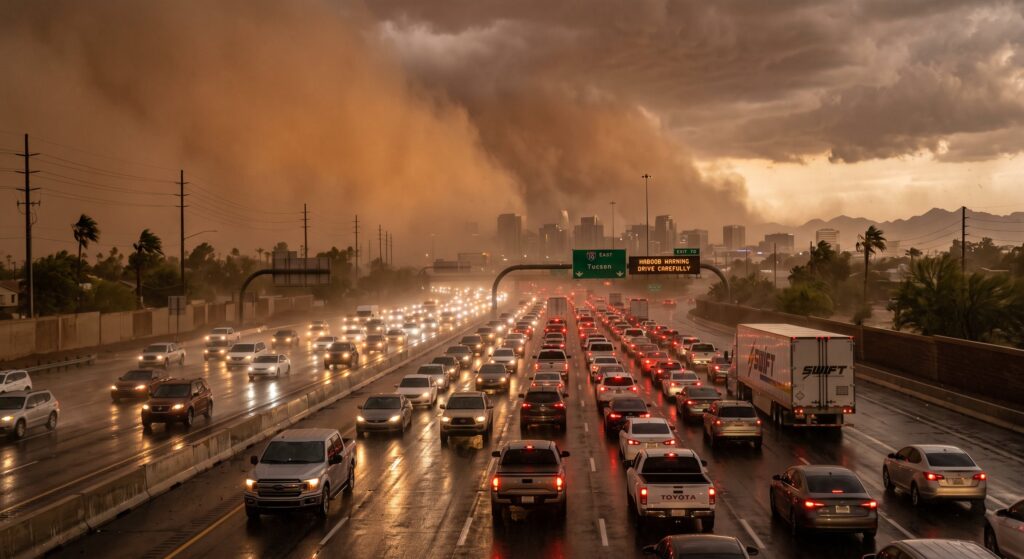
Arizona’s monsoon season runs from June 15 through September 30, and the storms it produces — sudden flash floods, haboobs that reduce visibility to zero, and rain that turns dry desert roads into rivers in minutes — create some of the most dangerous driving conditions in the country. When a negligent driver causes a crash in those conditions, they do not get to hide behind the weather. Lerner and Rowe’s Phoenix automobile crash lawyer team has successfully represented these types of cases. If you need an Arizona monsoon car accident lawyer, our team can investigate your wreck and fight for the full compensation you deserve.
Monsoon crash claims in Arizona are frequently more complex than standard car accident claims because insurers argue that weather was the primary cause and that the driver bears limited responsibility. Lerner and Rowe’s accomplished injury attorneys know how to counter that argument and win you the full settlement you’re entitled to under Arizona law.
Causes of an Arizona Monsoon Car Accident
An Arizona monsoon car accident can originate from any of the specific weather phenomena that characterize the season, but in every case the legal question is the same: did the driver exercise reasonable care for the conditions they were operating in? The following causes are the most common in Maricopa County monsoon crash claims.
- Flash flooding on low-water crossings: The Salt River bed crossings, the Agua Fria River corridor along I-10, and dozens of underpasses throughout Phoenix flood rapidly during monsoon downbursts. Drivers who enter flooded roadways despite warning signs are negligent — Arizona law prohibits driving around barriers at flooded roads, and violating that law creates civil liability.
- Hydroplaning on wet freeways: Phoenix’s road surfaces accumulate months of oil and debris during dry season that become a slick film when the first monsoon rains arrive. A driver who maintains freeway speeds when the road is visibly wet and loses control has failed to adjust for conditions.
- Reduced visibility in haboobs: Dust storms can reduce visibility to zero in seconds. Arizona’s “Pull Aside, Stay Alive” standard requires drivers to pull completely off the road, turn off their lights, and wait out the storm. Drivers who continue driving or pull to the shoulder with lights on create crash scenarios that injure other motorists.
- Running red lights at flooded intersections: Drivers who accelerate through intersections to avoid stopping in pooling water frequently run red lights, creating T-bone collision scenarios at some of Phoenix’s busiest corridors.
- Failure to maintain safe following distance: Wet roads and reduced visibility both require dramatically extended following distances. Drivers who tailgate in monsoon conditions are responsible for every rear-end crash they cause.
Handling a Dust Storm Accident Arizona
A dust storm accident Arizona claim requires proving that the at-fault driver failed to follow the protocols that Arizona law and the Arizona Department of Transportation (ADOT) require. Specifically, a driver who continued driving during a haboob — or who pulled to the shoulder with lights on rather than exiting the road entirely — violated the “Pull Aside, Stay Alive” standard, and that violation is the legal foundation of a negligence claim.
Dust storm conditions on I-10 between Phoenix and Casa Grande are documented on ADOT’s camera network and 511 traffic system. Weather records, ADOT camera footage, and highway patrol reports all document the specific visibility conditions at the time of the crash. Lerner and Rowe requests that evidence immediately after being retained — the data that proves a driver chose to keep moving through zero visibility is exactly what the insurer will try to explain away.
Liability in an Arizona Monsoon Car Accident
Arizona’s pure comparative fault system means you can recover damages from an Arizona monsoon car accident even if you were partly responsible for the crash. Your award is reduced proportionally by your percentage of fault, but you are never completely barred from recovery. The at-fault driver’s insurer will argue that the weather was the real cause and that both drivers share equal responsibility — Lerner and Rowe’s skilled Arizona attorneys build the evidence record that establishes the other driver’s specific negligent actions as the actual cause of the crash.
Liability in monsoon crash claims can extend beyond the at-fault driver. A city or county that failed to maintain adequate drainage in a known flood zone, or that did not install appropriate warning signage at a chronically flooded low-water crossing may share liability. ADOT’s failure to deploy message boards warning of haboob conditions on a stretch of highway where conditions were known may also be relevant. Lerner and Rowe investigates every angle simultaneously.
Filing a Hydroplaning Accident Claim Arizona
A hydroplaning accident claim Arizona requires establishing that the driver failed to reduce speed when road conditions made hydroplaning a foreseeable risk. Arizona’s traffic code requires drivers to adjust their speed to match road conditions — specifically including wet or slippery surfaces. A driver who was traveling at 65 mph on a visibly wet Phoenix freeway and lost control has violated that standard, and the resulting crash is a negligence claim, not a weather event.
Evidence in a hydroplaning claim includes dashcam footage showing road conditions, weather data documenting the rainfall intensity at the time of the crash, and expert accident reconstruction testimony that calculates the driver’s speed relative to safe stopping distances in wet conditions. Lerner and Rowe works with accident reconstruction specialists who have testified in Maricopa County courts and who know how to present that analysis compellingly.
Evidence for an Arizona Monsoon Car Accident
Monsoon crash evidence has a short shelf life. Flooded roadways drain and dry within hours of a storm. Haboob conditions on ADOT cameras get overwritten on rolling schedules. Weather service data is archived but requires a specific request. Lerner and Rowe sends evidence preservation demands to ADOT, local law enforcement, and the relevant county flood control district on the same day we are retained — before any of that documentation disappears.
The physical crash scene in a monsoon accident often carries evidence that does not exist in a dry-weather crash: water line marks on vehicles and barriers that document flood depth, silt deposits that show where water was flowing, and skid mark patterns that establish vehicle speeds before impact. Lerner and Rowe documents all of that before the next storm event washes it away.
A Phoenix Rain Accident Attorney Gathers Proof
A Phoenix rain accident attorney from Lerner and Rowe pursues a specific evidence package in every monsoon crash case. This includes the ADOT 511 traffic camera archive for the crash corridor, the National Weather Service precipitation data for the exact time and location, the responding officer’s incident report, and any available dashcam footage from the at-fault vehicle or surrounding cars. In flash flood crashes, the Maricopa County Flood Control District’s real-time gauge data documents exactly how high the water was at the time of the collision.
Witness testimony is especially important in monsoon crashes because other drivers who observed the at-fault driver’s behavior — continuing to drive through zero-visibility haboob conditions, entering a flooded underpass at speed, failing to turn on headlights — provide direct evidence of the specific negligent act. Lerner and Rowe contacts and interviews those witnesses before their memories fade and their contact information becomes difficult to recover.
Arizona Monsoon Car Accident FAQ
Lerner and Rowe’s Arizona monsoon car accident lawyer team handles these questions every monsoon season. Here are the answers that matter most to injured drivers and their families.
The value of an Arizona monsoon car accident claim depends on the severity of the injuries, the extent of the at-fault driver’s negligence, and the available insurance coverage. Recoverable damages include emergency medical treatment, surgery, rehabilitation, lost wages, loss of future earning capacity, and pain and suffering.
In cases involving catastrophic injuries or wrongful death, life care planning accounts for decades of future costs that the settlement must reflect. Lerner and Rowe builds the demand from the documented evidence before any number goes across the table.
The driver who entered the flooded roadway despite warning signs, who failed to maintain safe following distance on a wet freeway, or who ran a red light to avoid stopping in pooling water is the at-fault party. Arizona’s “Don’t Drown, Turn Around” law specifically prohibits driving around barriers at flooded roads. A driver who violated that law and caused a crash is liable for every injury the collision produced.
Arizona uses a pure comparative fault system, meaning your damages are reduced by your percentage of fault but you are never completely barred from recovery. Even a driver who was 40 percent at fault can recover 60 percent of their damages. In monsoon crashes, insurers commonly try to split fault 50/50 between drivers — Lerner and Rowe counters that strategy with the evidence that establishes where the real negligence lies.
No — at least not in a way that eliminates driver liability. An act of God defense requires that the event was entirely unforeseeable and that the defendant had no opportunity to respond to it. Arizona’s monsoon haboobs are a seasonal, documented phenomenon. A driver who chose to keep moving through a haboob rather than pulling off the road as ADOT protocols require made a negligent decision that the weather itself did not force. That decision — not the weather — is what creates liability.
No. Arizona law requires drivers to adjust their speed and following distance to match road conditions. Bad weather increases the standard of care required — it does not reduce it. A driver who maintains freeway speeds in a monsoon downburst, who drives through a haboob, or who enters a flooded roadway has failed to meet the heightened standard of care that those conditions demand. Lerner and Rowe’s Phoenix automobile crash lawyers know exactly how to establish that failure as the cause of your crash.
Justice for an Arizona Monsoon Car Accident
Injured victims of Arizona monsoon car accidents face a specific challenge: insurers who use the weather as a shield to minimize or deny claims. Every version of that argument has a counter, and Lerner and Rowe’s Arizona monsoon car accident lawyer team has built the evidence record that dismantles it in Maricopa County cases every monsoon season.
We pursue every liable party — the at-fault driver, their insurer, and, where applicable, the government entities whose maintenance failures contributed to the crash — simultaneously and aggressively.
Lerner and Rowe has achieved billion-dollar results for injury victims across the country. We work with accident reconstruction specialists, weather data experts, and medical professionals to build the demand that reflects what an Arizona monsoon car accident actually costs — not the minimum the insurer wants to pay.
Prioritizing Monsoon Driving Safety in Arizona
Monsoon driving safety in Arizona requires specific decisions that most out-of-state drivers and many Phoenix residents have not been trained to make. Pull completely off the road when visibility drops below a safe driving threshold in a haboob — not to the shoulder, but completely off the paved surface. Never drive into flooded roadways regardless of apparent depth. Turn headlights on when using wipers. These are not suggestions — they are legally required standards of care in Arizona, and violating them creates liability.
The Mortgage Matchup Center corridor on I-10 near the Papago interchange, and the Sky Harbor International Airport access roads, are among the highest-traffic areas in Phoenix that see significant flash flooding during monsoon events. Drivers who choose to navigate those corridors at speed during active storm conditions are making a decision that creates legal exposure when they cause a crash.
Call a Trusted Arizona Monsoon Car Accident Lawyer
The Phoenix personal injury attorneys at Lerner and Rowe are available 24 hours a day, 7 days a week. Our team handles Arizona monsoon car accident claims, flash flood liability disputes, and complex weather-related injury cases every monsoon season. You can trust our distinguished Phoenix automobile crash lawyer team to fight for the highest compensation allowed under Arizona law while you focus on your recovery. And remember, you pay nothing unless we win thanks to our “No Fee Promise.”
Call Lerner and Rowe today to schedule your free consultation. We’re available by phone at (602) 977-1900. You can also reach us online through our LiveChat representatives or by submitting your case details through our encrypted contact form.
The information on this blog is for general information purposes only. Nothing herein should be taken as legal advice for any individual case or situation. This information is not intended to create, and receipt or viewing does not constitute, an attorney-client relationship.