



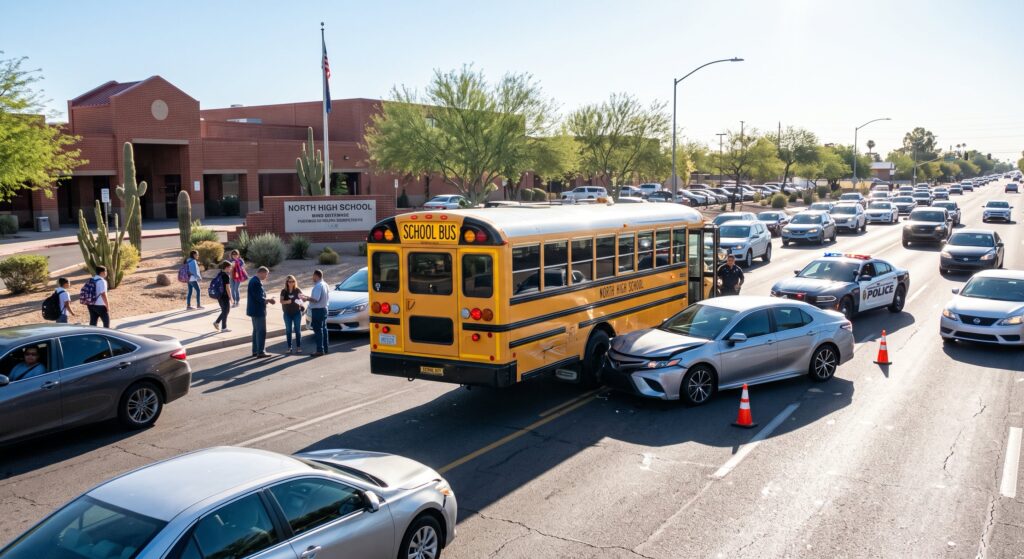
August returns school traffic to Phoenix’s arterial corridors — Bell Road, Thomas Road, Camelback Road — and the result is a predictable spike in congestion, rushed driving, and distracted motorists navigating unfamiliar drop-off zones. Phoenix back-to-school car crashes concentrate around school campuses during the morning drop-off and afternoon pickup windows, when the density of vehicles, pedestrians, cyclists, and school buses reaches its seasonal peak. Lerner and Rowe’s Phoenix automobile accident lawyer team investigates these crashes and fights to recover every dollar injured victims and their families deserve.
Arizona’s school zone laws impose specific obligations on drivers, and violations of those laws carry significant legal consequences in civil injury claims. Lerner and Rowe’s accomplished injury attorneys know those laws and know how to use them to build liability cases that hold negligent drivers fully accountable.
Causes of Phoenix Back-to-School Car Crashes
Phoenix back-to-school car crashes result from predictable driver behaviors that intensify during the back-to-school rush. The causes our attorneys see most frequently in Maricopa County school zone crash claims include the following.
- Distracted driving: Drivers managing GPS navigation to unfamiliar school drop-off zones, looking at their phones for carpool coordination messages, or managing children in the vehicle are a primary source of back-to-school crash risk.
- Failure to yield to pedestrians: Arizona law requires drivers to yield to pedestrians in all marked and unmarked crosswalks. School zone crossings during drop-off and pickup generate heavy pedestrian traffic that drivers who are rushing frequently roll through without stopping.
- Aggressive driving in congested corridors: Drivers who are late for work after dropping off children make aggressive lane changes and run yellow lights on Bell Road, Thomas Road, and Camelback — producing the intersection crashes that define back-to-school accident season in Phoenix.
- Failure to observe flashing school zone signals: Arizona’s 15 mph school zone speed limit applies when flashing signals are active. Drivers who maintain normal speed through active school zones are violating a posted safety law that creates civil liability when they cause a crash.
- Improper U-turns near school entrances: Drivers who miss the designated drop-off entrance and execute U-turns on active arterial streets create sudden, unexpected conflicts for other drivers who had no reason to anticipate the maneuver.
A Distracted Driver Collision in Phoenix, Arizona
A distracted driver collision in Phoenix, Arizona during back-to-school season is documentable through phone records, dashcam footage, and traffic camera data from the city’s intersection camera network. A driver who was interacting with their phone — checking a carpool app, texting another parent, or adjusting navigation — in the seconds before a rear-end crash or a failure-to-yield collision has committed a documented act of negligence. Lerner and Rowe requests that evidence immediately after being retained, before the data is overwritten.
Arizona’s distracted driving law prohibits handheld phone use while driving. A driver who violated that law in a crash that caused injuries has committed negligence per se under Arizona law — the violation itself establishes fault without requiring the injured party to separately prove carelessness.
Traffic on Bell, Thomas, and Camelback Road
The Phoenix school corridors with the highest back-to-school crash concentrations are the major east-west arterials that run through densely developed residential and commercial zones. Thomas Road in central Phoenix carries commuter traffic past North High School at 1101 East Thomas — creating a concentrated conflict point where school traffic, bus pickups, and through-traffic compete for the same lanes during peak hours. Camelback Road generates similar conflicts near Arcadia High School on the east side and the dense residential neighborhoods of the Camelback corridor on the west.
Bell Road in north Phoenix is one of the highest-volume arterials in Maricopa County, running through a corridor with multiple PVUSD and DVUSD campuses whose drop-off and pickup traffic competes directly with the road’s standard commuter load. The intersections at Bell and Cave Creek, Bell and 7th Street, and Bell and 35th Avenue all produce back-to-school crash scenarios documented in Maricopa County crash data every August.
Arizona School Zone Safety and Traffic Laws
Arizona law establishes specific obligations for drivers in active school zones. The 15 mph speed limit applies when flashing signals are active, and violations carry enhanced fines. Passing a stopped school bus with red lights flashing is illegal in both directions on undivided roads and carries criminal penalties. Failure to yield to a pedestrian in a school zone crossing triggers civil liability for every injury the violation causes.
These laws are not suggestions — they are safety standards that create legal consequences when violated. When a driver’s violation of an Arizona school zone traffic law directly causes a back-to-school car crash in Maricopa County, that violation is admissible evidence of negligence in the resulting civil injury claim. Lerner and Rowe documents those violations as the foundation of the liability case.
School Zone Car Accident in Phoenix, Arizona
A school zone car accident in Phoenix, Arizona carries a specific evidentiary profile. School campuses are among the most heavily surveilled locations in any city — Central High School on North Central Avenue, North High on Thomas Road, and dozens of elementary and middle school campuses across Maricopa County all have exterior cameras that document the street activity near their entrances during school hours. Lerner and Rowe sends preservation letters to school administrators immediately after being retained, before their camera systems overwrite the footage.
A back-to-school traffic crash in Maricopa County, Arizona that occurs within the designated school zone also benefits from the heightened legal duty that applies to all drivers in those zones. A driver who causes a crash in a school zone where enhanced safety laws were in effect faces stronger liability exposure than a driver who causes the same crash on a standard road.
Injuries in Phoenix Back-to-School Car Crashes
Phoenix back-to-school car crashes produce injuries across the full spectrum of severity. Rear-end collisions in congested drop-off queues produce whiplash and cervical spine injuries that may not present fully for 24 to 48 hours after the crash.
T-bone crashes at school zone intersections — where a driver running a flashing school zone signal strikes a vehicle crossing with the right of way — produce high-force lateral impacts that cause broken bones, brain injuries, and thoracic injuries.
In the most severe school zone crashes — where a driver fails to stop for a school bus or strikes a pedestrian in a crosswalk — the injuries can produce outcomes that change lives permanently. Lerner and Rowe has helped Phoenix families navigate claims involving wrongful death, permanent disability, and the long-term medical costs that follow serious collision injuries.
Insurers and Phoenix Back-to-School Car Crashes
Insurance adjusters assigned to back-to-school crash claims in Phoenix carry a specific playbook: argue that the congested school zone environment means all drivers share partial fault, dispute the severity of soft tissue injuries that don’t appear on X-rays, and make an early offer before the victim understands the full extent of their injury.
The shady tactics insurance companies use to minimize school zone crash claims are well-documented, and Lerner and Rowe’s attorneys know exactly how to counter them.
Arizona uses a pure comparative fault system, meaning your recovery is reduced proportionally by your percentage of fault — but you are never completely barred from recovery. Even when an insurer argues shared fault, Lerner and Rowe builds the evidence record that minimizes your attributed percentage and maximizes the at-fault driver’s.
Defeating Adjuster Fault-Shifting Tactics
The most common fault-shifting argument in Phoenix back-to-school car crash claims is that the victim was also driving aggressively in a congested school zone and shares responsibility for the collision.
Lerner and Rowe counters that argument with the physical evidence — dashcam footage, traffic camera data, and the crash reconstruction analysis that establishes who was moving, who had the right of way, and who made the specific negligent decision that caused the wreck. We handle all communications with the at-fault driver’s insurer from the moment you retain us.
Damages for Phoenix Back-to-School Car Crashes
Recoverable damages in a Phoenix back-to-school car crash claim include emergency medical treatment, surgery and hospitalization, physical therapy and rehabilitation, lost wages during recovery, loss of future earning capacity if the injury produces permanent limitations, vehicle repair or replacement, and pain and suffering. In cases involving catastrophic injuries or wrongful death, life care planning accounts for future costs that the settlement must reflect.
Lerner and Rowe has recovered billions for injury victims across the country. Our attorneys work with medical specialists and financial experts to build demands that reflect what a Phoenix back-to-school automobile crash actually costs — not the minimum an insurer is willing to offer.
Seeking Compensation for a Car Accident in Arizona
Seeking compensation for a car accident in Arizona requires moving quickly. Traffic camera footage from Phoenix’s intersection camera network is retained on rolling schedules. School campus surveillance footage may be overwritten within 72 hours.
Dashcam footage from other vehicles disperses as drivers go about their day. Lerner and Rowe sends preservation demands on the day we are retained — not after a prolonged intake process — so no evidence disappears before it can support your claim.
Arizona’s statute of limitations for personal injury claims is two years from the date of the crash under ARS 12-542. Contact Lerner and Rowe as soon as possible after any back-to-school crash in Phoenix.
Handling Phoenix Back-to-School Car Crashes
What you do in the first 48 hours after a Phoenix back-to-school car crash determines how strong your eventual claim will be. Call 911 immediately — a Phoenix PD or DPS report documents road conditions, school zone signage, and witness information before the scene clears.
Get a same-day medical evaluation even if you feel functional — brain injuries and cervical spine injuries from rear-end crashes frequently have delayed symptom onset. Do not give recorded statements to any insurer before speaking with Lerner and Rowe.
Call Lerner and Rowe Injury Attorneys 24/7
Lerner and Rowe is available 24 hours a day, 7 days a week. Our Phoenix automobile accident lawyer team handles back-to-school crash claims, school zone liability disputes, and complex multi-vehicle injury cases every day. The consultation is free and you pay nothing unless we win thanks to our “No Fee Promise.” So the sooner you call, the sooner we can begin preserving the evidence that builds your case.
Legal Help with Phoenix Back-to-School Car Crashes
The Phoenix personal injury attorneys at Lerner and Rowe are available 24 hours a day, 7 days a week. Our team handles Phoenix back-to-school car crashes, school zone liability claims, and complex multi-party injury cases every day. You can trust our distinguished Phoenix automobile accident lawyer team to fight for the highest compensation allowed under Arizona law while you focus on your recovery.
Call Lerner and Rowe today to schedule your free, no-obligation consultation. We’re available by phone at (602) 977-1900. You can also reach us online through our LiveChat representatives or by submitting your case details through our encrypted contact form.