
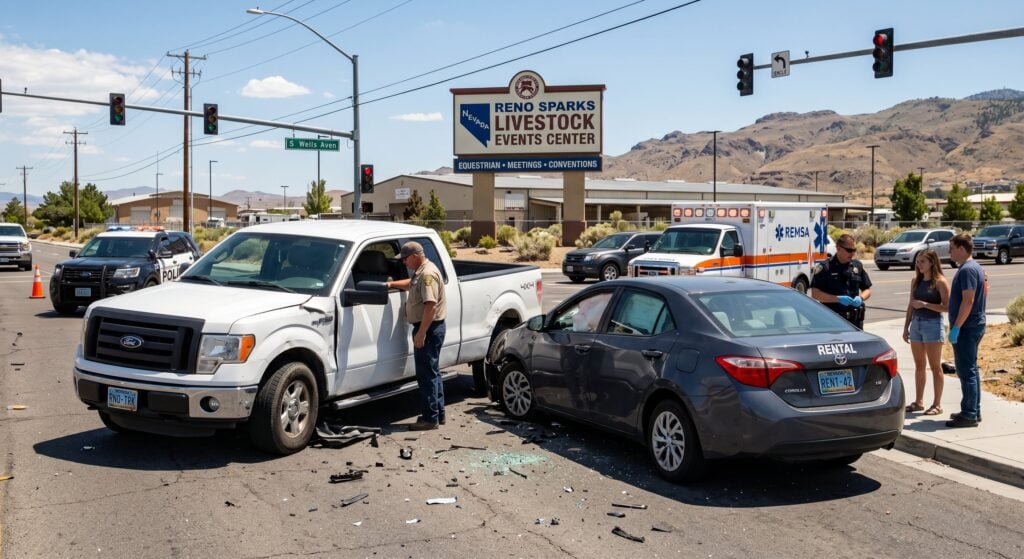
Every June, the Reno Rodeo draws tens of thousands of visitors to the Reno Livestock Events Center. This transforms the streets of South Reno into a maze of unfamiliar detours, overflowing parking lots, and excited out-of-town drivers who have never navigated the city. This also increases your chances of a Reno Rodeo traffic collision. If you’ve been injured in a wreck, a Reno car accident lawyer from Lerner and Rowe can make sure you receive the highest compensation allowed under Nevada law.
Event-related automobile crashes are rarely simple. The driver who hit you may be from out of state, driving a rental car, and insured by a company that has no intention of making the claims process easy. Lerner and Rowe’s accomplished attorneys handle the complexity so you can focus on your recovery.
Hazards Near the Reno Livestock Events Center
The Reno Rodeo runs for 10 nights each June, and for the duration of the event the streets surrounding the Livestock Events Center operate at or beyond their practical capacity. Thousands of vehicles converge on a relatively compact grid, many driven by visitors who arrived that day and have no familiarity with local traffic patterns. The result is a pressure-cooker environment where distracted driving, aggressive parking maneuvers, and sudden pedestrian crossings create collision hazards at nearly every intersection.
A Reno Rodeo traffic collision in this zone can happen anywhere from a parking lot exit to a major arterial. Pedestrians moving between the venue and surrounding bars and restaurants along South Virginia Street spill into crosswalks and mid-block gaps at all hours, and drivers who are watching for a parking spot instead of the road ahead are exactly the risk that Lerner and Rowe’s attorneys see in crash reports every summer.
Navigating Wells Avenue and Sutro Street
Wells Avenue and Sutro Street carry the heaviest vehicle load during Reno Rodeo events. Both corridors feed directly into the primary parking fields around the Livestock Events Center, and both become severely congested in the hour before and after each performance. Drivers unfamiliar with the area are prone to sudden lane changes, missed turn signals, and last-second braking when they realize they have passed their intended turn.
The intersection of Wells Avenue and Sutro Street is particularly high-risk during event nights. Vehicles exiting the venue grounds cross active traffic lanes with minimal signage, and the backup from that crossing regularly extends several blocks in each direction. A car wreck at that intersection during peak egress can involve multiple vehicles and produce injuries ranging from whiplash to serious bone fractures that require immediate emergency care.
Causes of a Reno Rodeo Traffic Collision
Summer driving risks in Nevada spike during large outdoor events, and the Reno Rodeo is one of the most concentrated sources of event-related traffic congestion in northern Nevada. A Reno Rodeo traffic collision during the event window typically involves one or more of the following contributing factors, each of which can form the basis of a negligence claim.
- Distracted driving: Distracted drivers navigating GPS reroutes, searching for parking, or watching rodeo signage instead of the road ahead cause a disproportionate share of rear-end crashes and intersection collisions near the venue.
- Impaired driving: Post-rodeo celebrations contribute to a measurable increase in impaired driving on Washoe County roads in the hours after each performance. A driver impaired by alcohol is liable for every injury their negligence causes.
- Unfamiliar road layout: Out-of-town visitors frequently misjudge turning radii, miss yield signs, and merge aggressively on streets they have never driven before, creating sudden hazards for local drivers who know the area well.
- Pedestrian conflicts: Heavy foot traffic around the venue spills into active lanes and crosswalks throughout the event, which can lead to pedestrian accidents.
- Rideshare congestion: Uber and Lyft demand surges after performances, flooding surrounding streets with rideshare vehicles that stop suddenly to pick up passengers, blocking sight lines and compressing active traffic.
Distracted Drivers and Out-of-Town Tourists
The majority of drivers involved in a Reno Rodeo traffic collision are not local residents. Out-of-town visitors to the rodeo tend to drive more slowly in unfamiliar areas while simultaneously paying less attention to the road, a dangerous combination in a congested event zone. Many are managing navigation apps, looking for their hotel, or making post-event plans while still behind the wheel.
A Washoe County distracted driving lawyer at Lerner and Rowe knows how to prove that an out-of-state driver’s inattention caused your crash. Phone records, dashcam footage from the scene, and traffic camera data near the Livestock Events Center can all establish what that driver was doing in the seconds before impact, and that evidence is most accessible immediately after a crash.
Steps after a Reno Rodeo Traffic Collision
The actions you take in the hours immediately following an automobile wreck during the Reno Rodeo directly affect the strength of your injury claim. Evidence near a major event venue changes fast. Parking lots get cleared, witnesses disperse, and traffic camera footage is routinely overwritten within 24 to 72 hours. Moving quickly gives your attorney the material they need to build a compelling case.
- Seek a same-day medical evaluation: Traumatic brain injuries, spine injuries, and internal damage frequently present delayed symptoms. A same-day medical record creates the direct evidentiary link between the crash and your condition that insurers will try to dispute.
- Call 911 and get a police report: A formal crash report documents the road conditions, intersection configuration, and the involved parties at the time of the collision. Do not skip this step even if the other driver suggests handling it privately.
- Photograph everything before you leave: Capture vehicle positions, road markings, signage, any debris, and your visible injuries. Wide shots showing the surrounding area help reconstruct what happened.
- Do not give recorded statements: The other driver’s insurer may contact you within hours. Decline any recorded statement until you have spoken with an attorney.
- Collect witness information: Event crowds mean potential witnesses are everywhere. Get names and contact information from anyone who saw the crash before they leave the area.
Documenting Washoe County Crash Evidence
Washoe County and the City of Reno maintain traffic camera infrastructure at key intersections near the Livestock Events Center. Lerner and Rowe’s attorneys know how to request that footage through proper legal channels before it is automatically deleted. We also send preservation letters to businesses whose private security cameras may have captured the crash and, where necessary, seek court orders to prevent evidence from being destroyed.
An I-80 car crash in Reno presents its own evidence challenges because freeway footage is managed by NDOT and subject to different retention schedules than city camera systems. If your automobile crash occurred on or near the I-80 interchange, your attorney needs to act within days, not weeks, to preserve that footage.
Damages in a Reno Rodeo Traffic Collision
The injuries from a serious automobile crash during a high-congestion event can be life-altering. Even a relatively low-speed rear-end collision in bumper-to-bumper rodeo traffic can produce whiplash and spine injuries that take months to treat and may result in permanent limitations. Higher-speed crashes on Wells Avenue or the I-80 corridor produce catastrophic injuries, including traumatic brain injuries that require extended rehabilitation and significant long-term care.
Recoverable damages in a Reno Rodeo traffic collision claim include emergency medical treatment, surgery and hospitalization, physical therapy and rehabilitation, lost wages and loss of earning capacity, property damage and vehicle repair or replacement, and pain and suffering. Lerner and Rowe’s attorneys work with medical specialists and financial experts to calculate the full value of your claim, including future costs that insurance companies routinely try to exclude from settlement offers.
Dealing with Out-of-State Insurance Claims
When the driver who caused your car wreck is from out of state, their insurance company will not be familiar with Nevada law, and that unfamiliarity is something adjusters try to use to their advantage. They may misrepresent Nevada’s comparative fault rules, apply their home state’s coverage limits, or delay the claims process hoping you will accept a low settlement before you understand what your injuries will actually cost.
A Sparks auto injury attorney at Lerner and Rowe handles out-of-state insurance claims regularly and knows how to ensure Nevada law governs every aspect of your recovery. We handle all direct communication with the insurer, counter lowball offers with documented medical and financial evidence, and take the case to trial if that is what it takes to get you what you deserve.
Contact a Reno Rodeo Traffic Collision Attorney Near Me
The Reno injury attorneys at Lerner and Rowe are available 24 hours a day, 7 days a week. Our team handles Reno Rodeo traffic collision claims, out-of-state insurance disputes, and complex multi-vehicle crashes every day, and we fight to recover the highest compensation allowed under Nevada law. You can trust our accomplished Reno car accident lawyer team to handle every aspect of your claim so you can focus on your health.
Call Lerner and Rowe today to schedule your free, no-obligation consultation. We’re available by phone at (775) 644-4444. You can also reach us online through our LiveChat representatives or by submitting your case details through our secure contact form.
The information on this blog is for general information purposes only. Nothing herein should be taken as legal advice for any individual case or situation. This information is not intended to create, and receipt or viewing does not constitute, an attorney-client relationship.