



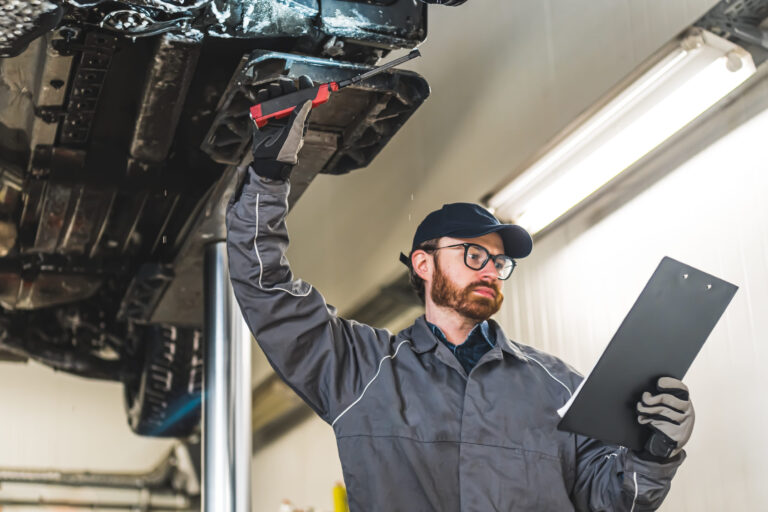
For years, Texas drivers were required to undergo an annual safety inspection. However, Texas HB 3297 removed the inspection requirement for everyday vehicles, but it did not remove a driver’s legal duty to keep that vehicle safe. This change has led to questions about liability in accidents involving poorly maintained vehicles in Texas. If you or a loved one have been involved in such a crash, you can still file an injury claim if the driver of the poorly maintained vehicle caused your accident.
In this blog, Lerner and Rowe’s El Paso personal injury lawyers explain what the law actually changed, what it didn’t, and how fault is decided when a mechanically unsafe vehicle causes a wreck.
What Texas HB 3297 Changed About Vehicle Safety Inspections
Passed by the 88th Legislature, Texas HB 3297 eliminated the mandatory annual Texas vehicle safety inspection program for non-commercial vehicles. In its place, drivers now pay a $7.50 inspection program replacement fee at registration.
Since the law took effect, non-commercial vehicles no longer need a vehicle safety inspection before registration, according to the Texas Department of Public Safety (TDPS). Newer vehicles pay a $16.75 fee up front to cover their first two years.
Several things stayed the same, though, and they matter after a crash.
- Commercial vehicles still require safety inspections, including the big rigs behind many serious truck accidents
- Equipment laws never changed, and officers can still cite drivers for defective equipment
This means that a family sedan no longer needs a sticker but the eighteen-wheelers do.
Texas HB 3297 Did Not Erase the Duty to Maintain a Safe Vehicle
Ending the inspection program did not give anyone a pass to drive a dangerous vehicle. Every Texas driver still has a legal duty to keep their car roadworthy, and equipment violations remain enforceable by law enforcement. A bald tire or a failing brake system was illegal before Texas HB 3297, and those vehicles that fail to meet the requirements of Chapter 547 of the Texas Transportation Code remain unlawful to operate. The primary change is that Texas no longer requires most non-commercial vehicles to undergo annual state safety inspections before registration.
That did not stop the state from holding drivers accountable when worn-out equipment leads to an El Paso car accident. Now, the responsibility rests more clearly with each driver to keep up with their own maintenance.
Texas HB 3297 may have eliminated routine inspections for most passenger vehicles, but it did not repeal Chapter 547 of the Texas Transportation Code. Vehicles still have to comply with Texas equipment laws, and drivers can still be cited for defective or unsafe equipment.
Common Equipment Failures Behind Unsafe Vehicle Crashes
Texas Transportation Code 547 establishes minimum equipment standards that vehicles must meet to operate legally on Texas roads. This covers equipment like:
- Brakes and braking performance
- Tires and tread depth
- Headlights, taillights, and brake lights
- Steering and suspension components
- Mirrors, windshields, and wipers
- Horns and warning devices
Any one of these can turn a small lapse into a serious crash. Worn brake pads stretch a stopping distance by car lengths. Bald tires lose their grip in the rain. A burned-out taillight leaves the driver behind you guessing.
These maintenance failures are especially dangerous in crashes involving motorcyclists, bicycles, and pedestrians, who have little protection from the force of an impact. Without mandatory vehicle inspections, many of these hazards are unnoticed until it is too late.
Unsafe Vehicle Accident Liability Under Texas HB 3297
Without these vehicle inspections, the question of liability remains. In a personal injury claim, a violation of Texas equipment laws may be evidence that the driver failed to exercise ordinary care. Whether the violation constitutes negligence depends on the facts of the case and whether the defective condition contributed to the crash.
Negligence, in simple terms, means failing to act with the care a reasonable person would use. A driver who knew, or who, through reasonable inspection and maintenance, should have known, that their vehicle had dangerous defects may be held liable if those defects contributed to a crash.
That principle is significant. It can apply to everyday collisions and to crashes severe enough to support a wrongful death claim when a family loses someone.
To recover damages, an injured person must still prove that the defective condition was the cause of the collision and the injuries that resulted. Proving that a vehicle should never have been on the road takes evidence. Some of the most useful sources include:
- Police reports and any equipment-related citations issued at the scene
- Repair and maintenance records showing ignored or overdue fixes
- A post-crash inspection of the vehicle by a qualified mechanic
- Photos of the damage, worn tires, or failed components
- Witness accounts describing how the crash unfolded
Because most non-commercial vehicles no longer undergo annual state safety inspections, there are generally no recent state inspection records documenting a vehicle’s condition before the crash. That makes this kind of documentation more important, not less. Gathering it quickly, before a vehicle is repaired or scrapped, can be critical to a claim.
When your crash happened is also important. If it occurred while the inspection program was still in place, an expired or failed inspection record may be part of the picture. If it happened afterward, that paper trail generally won’t exist, and showing the vehicle’s condition rests on the kinds of evidence listed above. Either way, the driver’s underlying duty to keep the vehicle safe is the same.
Comparative Fault: How Much Can You Recover in Texas?
Even in a crash tied to bad equipment under Texas HB 3297, fault is rarely all on one side. Texas follows a modified comparative fault rule, known as proportionate responsibility. In everyday language, more than one person can share the blame for a crash, and your percentage of fault reduces your compensation.
Here’s the threshold that matters: you can still recover damages as long as your share of the fault is 50% or less. Cross into 51%, though, and you’re barred from recovering anything at all.
For example, you might be found 20% at fault for being slightly over the speed limit, while the other driver is 80% at fault for running a light on tires so worn they couldn’t stop in time. You can still recover, but your award is trimmed by your 20% share. If a jury values your damages at $100,000, you would receive $80,000.
That’s why insurance companies work so hard to pin more blame on injured victims. Every percentage point they shift onto you is money out of your pocket, and in borderline cases it can wipe out a claim entirely. This scenario plays out in all kinds of crashes, including pedestrian accidents, where an at-fault driver may argue the person on foot shares the blame.
Having someone build your case and document the other driver’s equipment failures can be the difference between a fair recovery and a lowball offer.
Injured by an Unsafe Vehicle? Call an El Paso Car Accident Attorney
If a poorly maintained vehicle left you hurt, you shouldn’t have to pay for someone else’s negligent or reckless actions. Our Texas attorneys are ready to fight for the justice and compensation you deserve. Our team is available 24/7 to help you understand your options.
To schedule a free case review, call (281) 975-6222, reach us through LiveChat, or fill out our online contact form.
Lerner and Rowe Injury Attorneys has recovered billions of dollars for clients nationwide, with over a billion in just the past three years. And with no fees unless we win, there’s no risk in reaching out.
The information on this blog is for general information purposes only. Nothing herein should be taken as legal advice for any individual case or situation. This information is not intended to create, and receipt or viewing does not constitute, an attorney-client relationship.