



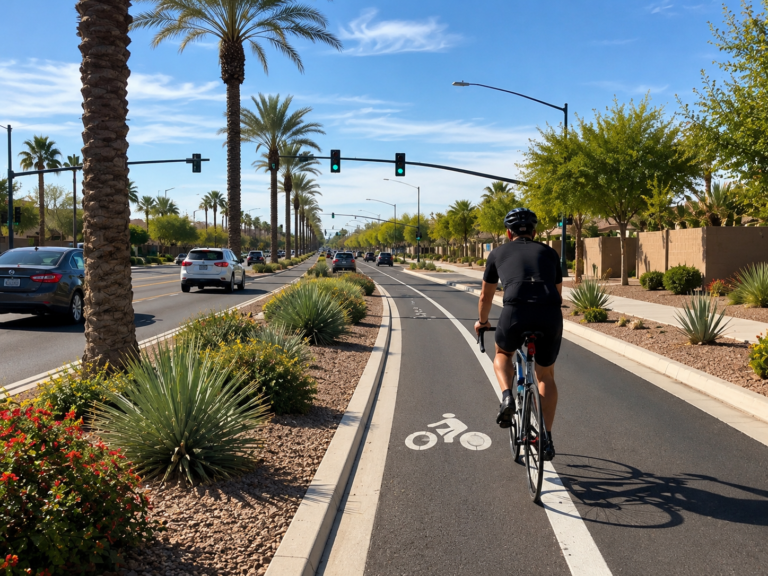
On any given evening along Gilbert’s Santan Vista Trail or the Western Canal path, you’ll find dozens of cyclists pedaling home from work, running errands, or squeezing in a workout before dark. The town has built a reputation as one of the more bike-friendly communities in the East Valley, but more riders on the road also means more chances for a distracted or impatient driver to make a costly mistake. Lerner and Rowe’s Gilbert bicycle accident lawyers know that Gilbert bicycle safety depends on more than painted lanes. It depends on drivers understanding the law and on insurance companies being held to it when they try to blame the cyclist instead.
In this blog, we will walk you through Arizona’s bicycle right-of-way and three-foot passing laws, the “cyclist came out of nowhere” defense that insurers rely on, how Gilbert’s expanding bike lane network is changing local roads, the hidden danger of dooring near residential driveways, and why the evidence you gather after a crash can matter more than the police report.
Gilbert Bicycle Safety and Arizona’s Right-of-Way Law
Arizona bicycle right of way law starts with Arizona Revised Statutes § 28-812, which gives a person riding a bicycle on a roadway all the same rights and the same duties as the driver of a car. That means cyclists are entitled to full right-of-way protections at intersections, stop signs, and traffic signals, just like any other vehicle on the road.
Riders are generally required to stay as far right as practicable, with reasonable exceptions for passing, turning left, or avoiding road hazards and parked cars. Riders are also expected to follow basic equipment rules, such as using a front light and rear reflector visible from a distance after dark, since a driver who claims they “never saw” a cyclist will often point to a missing light as part of their defense.
Arizona’s Three-Foot Passing Law for Cyclists
Arizona also has one of the more specific overtaking laws in the country. Under ARS § 28-735, a driver passing a cyclist must leave at least three feet of space until safely past. A violation that causes serious injury can carry a civil penalty of up to $500 and up to $1,000 if it causes a death.
However, those enhanced penalties don’t apply if the cyclist was hit in a traffic lane and a bike lane or path was nearby. In Gilbert bicycle accident claims, insurers often use that distinction to avoid paying.
When Insurers Say the Cyclist “Came Out of Nowhere”
If you’ve filed a claim after a driver hit you while you were riding, you may already recognize the phrase. Adjusters often argue the rider appeared suddenly, swerved unpredictably, or was impossible to see in time, shifting fault away from the driver and onto you.
Arizona follows a pure comparative negligence rule, which means an injured cyclist can still recover damages even if partially at fault, though the award is reduced by their percentage of responsibility. That structure gives insurers an incentive to inflate the cyclist’s share of the blame, even in cases involving distracted driving, where the driver simply wasn’t looking at the road at all.
The truth is that most “came out of nowhere” car accident claims fall apart under scrutiny. Sight lines, speed, reaction time, and roadway design usually tell a very different story than the one an adjuster wants to write. Documenting the scene quickly and having an attorney push back on unsupported claims is often what stands between a fair settlement and a lowball offer.
Gilbert Bicycle Safety and the Growing Bike Lane Network
Gilbert has been steadily investing in bicycle infrastructure. The town piloted green bike lanes at Gilbert and Warner Roads before expanding the program to several other high-traffic intersections:
- Gilbert and Guadalupe Roads
- Val Vista and Warner Roads
- Val Vista and Elliot Roads
- Recker and Williams Field Roads
In 2026, town leaders launched a broader bicycle network study aimed at connecting existing lanes into a more continuous, rider-friendly system. While the growth is good news for safety overall, new infrastructure also creates new areas where accidents can happen. Every added intersection is a place where a driver might turn across a bike lane without checking for riders, and lanes running past driveways and parking areas raise pedestrian accident risks as well.
Corridors like Val Vista Drive and Recker Road see heavy commuter traffic during morning and evening rush hours, exactly when visibility is lowest and drivers are most likely to be rushing. As Gilbert’s network expands, drivers need to adjust their habits just as quickly as the town lays new pavement.
Dooring Accidents Near Gilbert Driveways
Many of Gilbert’s newer subdivisions place bike lanes directly alongside street parking and residential driveways, creating a common but often overlooked hazard: dooring. This happens when a driver or passenger opens a car door into the path of an oncoming cyclist, giving the rider little to no time to react.
Arizona law addresses this directly. A person may not open a vehicle door unless it’s reasonably safe to do so, and doors may not be left open into traffic longer than necessary to load or unload. Violating this duty is treated as evidence of negligence, and the person who opened the door is almost always held liable, even if the cyclist was riding legally within a marked lane.
Dooring collisions can be deceptively serious; riders are often thrown from their bikes into an active traffic lane, resulting in significant injuries and, in the worst cases, a wrongful death claim for the family left behind. Because these crashes tend to happen at low speed in quiet residential areas, they’re sometimes dismissed as minor by the parties involved until the rider’s injuries prove otherwise days later.
Police Reports vs. Witness and Helmet-Cam Evidence
After a crash, most people assume the police report will settle the question of fault. In reality, it’s just a starting point. Officers usually arrive after the collision has already happened, and their conclusions often rely on secondhand statements, skid marks, or a driver’s version of events rather than a full picture of what occurred.
That’s why independent evidence matters so much in a bike accident injury claim Maricopa County residents file after a crash. Sources that can contradict a flawed report or fill in gaps the responding officer never saw include:
- Witness statements gathered at the scene
- Surveillance footage from nearby homes or businesses
- Helmet-cam or bike-computer footage
- Doorbell camera footage from residential neighborhoods, which often captures the moments leading up to a dooring or right-hook collision from an angle no one else caught
Our legal team routinely tracks down this kind of evidence, because in close-call cases, it’s frequently the difference between an insurer accepting liability and denying it outright.
FAQs: Gilbert Bicycle Safety
Who is at fault in a bicycle accident in Arizona?
Fault depends on the facts, but Arizona’s comparative negligence system means fault can be shared. If a driver violated the three-foot passing law, ran a stop sign, or opened a door into a cyclist’s path, that typically weighs heavily against them, even if the cyclist bears some responsibility too.
Does Arizona require cyclists to use a bike lane if one is available?
Cyclists generally aren’t required to use a bike lane, though riding in one can affect how certain passing-law penalties apply if a collision occurs in the adjacent travel lane. An attorney can help you understand how these factors played into your specific situation.
What should I do immediately after a bike accident in Gilbert?
Seek medical care first; then, if possible, take photos of the scene, your bike, and any visible injuries, get contact information from witnesses, and request a copy of the police report. Avoid discussing fault with the other driver or their insurer.
How does comparative negligence affect a bike accident injury claim in Maricopa County?
Your percentage of fault may reduce your compensation, but you can still recover damages even if you were partly responsible. Insurers often try to inflate a cyclist’s share of blame, which is one reason many riders choose to speak with an attorney before accepting a settlement offer.
How long do I have to file a bicycle accident claim in Arizona?
Arizona generally allows two years from the date of the crash to file a personal injury lawsuit, though certain circumstances can shorten or extend that window. It’s important to speak with an attorney as soon as possible to protect your right to pursue compensation, whether that’s through our Phoenix office or our Gilbert location.
Gilbert Bicycle Safety: Our Attorneys Are Here to Help
Gilbert’s cyclists deserve roads where the rules are respected, not roads where insurance companies get to rewrite what happened. If you were hurt while riding, our team is available 24/7.
To schedule a free case review, call (602) 977-1900, reach us through LiveChat, or complete our online contact form.
We’ve recovered billions of dollars for our clients nationwide, with over a billion dollars in the past three years alone. And with no fees unless we win, there’s no risk in reaching out.
The information on this blog is for general information purposes only. Nothing herein should be taken as legal advice for any individual case or situation. This information is not intended to create, and receipt or viewing does not constitute, an attorney-client relationship.