



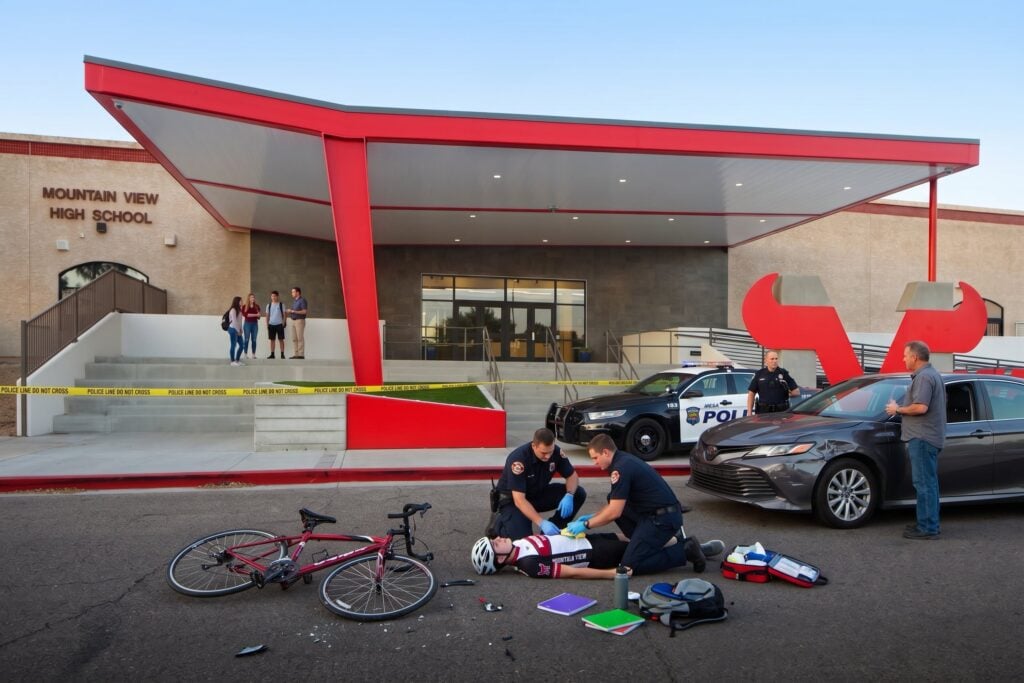
August brings a sudden and concentrated surge in bicycle traffic across Mesa’s school corridors, as students ride to Mesa Public Schools campuses and adult commuters take to the road in the early morning hours before the heat peaks. When that surge collides with rushed back-to-school drivers who are navigating drop-off zones, running late for work, and not watching their mirrors, Mesa back-to-school bicycle crashes follow predictably. A Mesa bicycle accident attorney from Lerner and Rowe can investigate your crash and fight for the full compensation you deserve.
Bicycle crash claims in Mesa involve a specific liability framework that most victims do not know about — Arizona’s right-of-way laws in school zones, the heightened duty drivers owe cyclists in designated bike lanes, and the pure comparative fault system that governs how damages are allocated. Lerner and Rowe’s accomplished attorneys know that framework and know how to use it to build the case that holds negligent drivers fully accountable.
Risks: Mesa Back-to-School Bicycle Crashes
Mesa back-to-school bicycle crashes concentrate in the morning drop-off and afternoon pickup windows — the same hours when the city’s school corridors carry their heaviest mixed vehicle and cyclist traffic. The Westwood High School campus near Main Street and Rio Salado Parkway and the Mountain View High School campus on East Brown Road both generate significant bicycle commuter activity on the surrounding arterial grid during August’s first weeks.
Drivers who are unfamiliar with the back-to-school traffic pattern or who are rushing to complete drop-off and return to work make the lane changes, right turns, and rolling stops that produce bicycle crashes at predictable locations.
Mesa’s designated bike lanes on major corridors provide a physical separation between cyclists and motor traffic, but that separation is only as safe as the drivers who cross it. A right-turning driver who fails to check the bike lane before executing the turn creates an unavoidable collision for a cyclist who was in the lane legally and with the right of way. Those crashes are not accidents — they are the predictable result of a driver who did not look.
Back-to-School Bicycle Accident in Mesa, Arizona
A back-to-school bicycle accident in Mesa, Arizona during the first two weeks of August is more legally documentable than most crash types because the school zone camera systems and city intersection cameras create a documented record of the crash environment.
Exterior cameras on Mesa Public Schools campuses capture street activity during school hours, and the city’s traffic camera network covers most arterial intersections on Southern Avenue and Main Street. Lerner and Rowe sends preservation letters to school administrators and the City of Mesa on the day we are retained, before any footage is overwritten.
A driver who causes a bicycle crash in an active school zone has violated Arizona’s heightened school zone safety requirements in addition to the underlying traffic law. That dual violation — the school zone speed limit breach and the underlying failure to yield or check mirrors — creates a stronger negligence per se foundation than a standard bicycle crash on a non-school arterial.
Congestion on Southern Ave and Mesa Drive
Southern Avenue and Mesa Drive are the two primary east-west and north-south arterials that carry the heaviest back-to-school cyclist and vehicle mix in Mesa. Skyline High School on Crismon Road near the US 60 corridor generates bicycle commuter traffic that feeds onto the Southern Avenue bike lane network, which connects multiple Mesa Public Schools campuses across the eastern half of the city.
The intersection density on Southern during school hours — with commercial driveways, residential cross streets, and school zone crosswalks all generating turning vehicle conflicts — makes it one of the highest-risk corridors for back-to-school bicycle crashes in Maricopa County.
Mesa Drive’s north-south corridor through central Mesa crosses multiple school zones and carries significant bicycle commuter traffic from neighborhoods where students without school bus access ride to campus. The combination of on-street parking that generates dooring hazards and the turning vehicle conflicts at commercial intersections on Mesa Drive makes it a documented bicycle crash concentration zone during every August school opening week.
Causes of Mesa Back-to-School Bicycle Crashes
Mesa back-to-school bicycle crashes result from a consistent set of driver failures that our Mesa bicycle accident attorney team identifies in every school-corridor crash investigation.
- Right-hook collisions: A driver who passes a cyclist and then turns right immediately across their path gives the rider no stopping distance. Near school zone intersections where right turns are frequent during drop-off hours, this crash type is one of the most common causes of serious bicycle injury in Mesa.
- Failure to yield in crosswalks: Arizona law requires drivers to yield to cyclists in marked crosswalks. Drivers who roll through school zone crosswalks without stopping for cyclists who have entered legally are responsible for every injury the violation causes.
- Distracted driving: Drivers managing carpool coordination messages, checking phones, or interacting with passengers during school drop-off fail to see cyclists in adjacent bike lanes or crosswalks. The 30 seconds of inattention that causes a bicycle crash due to distracted driving can produce injuries that take months to recover from.
- Dooring: Drivers and passengers who open car doors into active bike lanes without checking for approaching cyclists create unavoidable crashes for riders who have no time or space to stop. On-street parking adjacent to school zones on Mesa Drive and Southern Avenue makes this crash type particularly frequent during school hours.
- Speeding through active school zones: A driver who exceeds the 15 mph school zone speed limit when they strike a cyclist produces injuries that are dramatically more severe than a lower-speed impact would. That speeding violation is negligence per se and the foundation of the liability case.
Dooring Accident in Mesa, Arizona
A dooring accident in Mesa, Arizona is one of the most frequently underestimated bicycle crash types in personal injury litigation. Insurance adjusters for the vehicle owner typically argue that the cyclist should have been riding further from parked cars or that the door opened too quickly to be avoided.
Neither argument holds up under Arizona law when the vehicle occupant failed to check for approaching cyclists before opening a door into an active bike lane. The legal obligation to check before opening rests entirely with the vehicle occupant, not the cyclist.
Dooring crash evidence includes the physical damage pattern on the bicycle and the door, the cyclist’s documented road position from any available camera footage, and any witness statements from nearby pedestrians or other cyclists who observed the door opening. Lerner and Rowe’s skilled attorneys build the liability case from that evidence and counter every version of the comparative fault argument the insurer raises.
Unsafe Right Turns and Crosswalk Violations
Unsafe right turns and crosswalk violations are the two driver behaviors that produce the most severe Mesa back-to-school bicycle crashes because they involve a vehicle moving directly into a cyclist’s path at a moment when the rider has no ability to anticipate or evade the conflict. A driver who executes a right turn across an occupied bike lane without checking the mirror has committed a traffic violation — and when that violation injures a cyclist, the violation is direct evidence of negligence under Arizona’s negligence per se doctrine.
Lerner and Rowe requests dashcam footage from other vehicles, traffic camera data from the intersection, and any available school campus camera footage that may have captured the approach sequence before the crash. That combination of evidence frequently establishes the driver’s failure to check mirrors or yield in a way that no amount of insurer counter-argument can overcome.
Arizona Bicycle Right-of-Way Laws
Arizona law gives cyclists specific and enforceable protections in the traffic system. Cyclists operating in designated bike lanes have the right of way over motor vehicles turning across those lanes. Drivers must yield to cyclists before executing any turn that crosses a bike lane.
At intersections without bike lanes, cyclists have the same rights and obligations as motor vehicle operators — including the right to occupy the travel lane. A driver who argues that a cyclist “shouldn’t have been there” is arguing against Arizona statute.
The shady tactics insurance companies use to minimize bicycle crash claims frequently involve misrepresenting these legal rights — arguing that cyclists assumed the risk of their position on the road, that the driver could not have anticipated a cyclist in the lane, or that the cyclist’s own behavior contributed to the crash. Lerner and Rowe’s attorneys know Arizona’s bicycle right-of-way statutes and apply them as the foundational legal framework in every claim.
School Zone Bike Crash in Maricopa County, Arizona
A school zone bike crash in Maricopa County, Arizona carries the same heightened legal standards that apply to pedestrian crashes in school zones — with the additional protections that Arizona’s bicycle right-of-way laws provide. When a driver violates the school zone speed limit and strikes a cyclist, the liability case rests on two independent legal foundations: the school zone traffic violation and the bicycle lane right-of-way violation. Lerner and Rowe documents both violations as the foundation of every school zone bicycle crash claim in Mesa.
Injuries: Mesa Back-to-School Bicycle Crashes
Bicycle crash injuries reflect the complete absence of structural protection between the rider and the striking vehicle or the pavement. Road rash from contact with Mesa’s August asphalt — which exceeds 150 degrees during midday and retains significant heat into the morning commute window — produces deep tissue wounds with elevated infection risk. Broken bones — particularly clavicle, wrist, and arm fractures from bracing for impact — are among the most common outcomes in lower-speed bike crashes.
In higher-speed collisions, brain injuries from head contact with the vehicle or pavement are genuine risks even through a helmet. Spinal cord injuries from the force transfer of a vehicle impact produce outcomes ranging from temporary neurological deficits to permanent paralysis. At the most severe end, Mesa back-to-school bicycle crashes have resulted in catastrophic injuries and wrongful death that Lerner and Rowe has helped families navigate.
Fault in Mesa Back-to-School Bicycle Crashes
Arizona’s pure comparative fault system means a cyclist can recover damages from a Mesa back-to-school bicycle crash even if they contributed to the collision. The recovery is reduced proportionally by the cyclist’s percentage of fault, but it is never eliminated entirely.
The at-fault driver’s insurer will try to inflate the cyclist’s fault percentage — arguing that the rider was not wearing a helmet, was not using lights, or was riding too close to the parking lane. None of those arguments eliminate the driver’s legal obligation to yield the right of way.
Lerner and Rowe builds the evidence record that establishes the driver’s specific negligent act as the proximate cause of the crash and minimizes any attributed cyclist fault with the physical evidence — the road position documentation, the traffic law violations, and the camera footage that shows exactly what each party was doing in the seconds before impact.
Seeking Compensation for a Bicycle Accident in Arizona
Seeking compensation for a bicycle accident in Arizona requires building a demand that reflects the full arc of the injury — not just the emergency room visit. Recoverable damages include all medical treatment past and future, surgery and rehabilitation, lost wages during recovery, loss of future earning capacity if the injury produces permanent limitations, bicycle repair or replacement, and pain and suffering.
Arizona’s statute of limitations for personal injury claims is two years from the date of the crash under ARS 12-542. Best of all, you pay nothing unless we win thanks to our “No Fee Promise.”
Damages for Mesa Back-to-School Bicycle Crashes
Lerner and Rowe Injury Attorneys has recovered billions for injury victims across the country, including cyclists injured in school corridor crashes across Maricopa County. Our attorneys work with medical specialists to document the full injury arc — including future costs for reconstructive care, ongoing rehabilitation, and any permanent limitations — before any settlement number is placed on the table. A settlement that only covers the immediate treatment is not a fair settlement, and our Mesa bicycle accident attorney team will not accept one on your behalf.
Get Help with Mesa Back-to-School Bicycle Crashes
The Mesa personal injury attorneys at Lerner and Rowe are standing by to take care of all your legal needs. Our team handles Mesa back-to-school bicycle crashes, school zone liability disputes, and complex multi-party injury cases every day. With a proven track record of securing significant results for our clients, you can trust our experienced Mesa bicycle accident attorney team to fight to win you the highest settlement allowable under Arizona law.
Call us today to schedule your free, no-obligation consultation. We’re available 24 hours a day, 7 days a week by phone. You can also reach us online through our LiveChat agents or by submitting your case details through our secure contact form.
The information on this blog is for general information purposes only. Nothing herein should be taken as legal advice for any individual case or situation. This information is not intended to create, and receipt or viewing does not constitute, an attorney-client relationship.